

Today, a successful crawl is no longer a guarantee of a search presence. Google has shifted from an “index everything” model to a highly selective gatekeeper that aggressively devalues commodity content. You’ve likely invested heavily in high-intent pages only to find them trapped in the crawled – currently not indexed category within Google Search Console. It’s a frustrating scenario where your content budget is effectively wasted on invisible assets that fail to drive commercial value or visibility.
We understand that technical SEO alone is no longer enough to win a spot in the index. This guide provides the exact diagnostic framework you need to move priority pages out of GSC purgatory and back into the search results where they can generate revenue. You’ll learn how to align your content with Google’s current demand mapping standards and implement a strategic pivot that ensures your technical efforts translate into 100% indexing for your most critical assets. We’re moving beyond simple re-indexing requests to focus on building the authority and clarity that Google’s algorithms require.
Key Takeaways
- Identify the critical distinction between discovery and crawling to determine if your roadblock is technical capacity or a strategic quality assessment.
- Overcome the crawled – currently not indexed status by identifying thin or near-duplicate content that fails Google’s quality threshold.
- Separate easily fixable technical errors from deep-rooted strategic flaws to ensure your high-intent pages contribute to commercial growth.
- Deploy a proactive five-step remediation framework that forces a re-evaluation of your content’s value instead of waiting for automated updates.
- Build resilient Search Foundations through optimized site architecture to prevent future indexing gaps and maintain consistent organic visibility.
Understanding the ‘Crawled – Currently Not Indexed’ Status
The crawled – currently not indexed status indicates that Google has successfully accessed your URL but has consciously decided to exclude it from the search results. This is a deliberate choice by the algorithm; the technical handshake between your server and the search engine was completed, yet the content failed to meet the necessary value threshold for inclusion. Think of it as a “soft rejection” where the door was opened, but the guest was asked to leave before the party started. Distinguishing this from the “Discovered – currently not indexed” status is critical for a precise diagnosis. While “Discovered” means Google knows the URL exists but hasn’t visited it yet, the “Crawled” status confirms the visit happened and the content was deemed insufficient for the index.
Today, Google has become increasingly selective about what it chooses to store and serve. As AI-generated noise clutters the web, the search engine has raised the bar for what constitutes a useful page. If your reports show high volumes of this status, it suggests that while your technical foundations allow for access, your strategic execution lacks the depth required to earn a permanent spot in the index. Google’s current indexing priorities heavily favor sites that have established topical authority SEO, moving away from rewarding sheer content volume in favor of verified expertise and unique value.
Crawl vs. Index: The Crucial Difference
The difference lies in the distinction between discovery and storage; crawling is the act of reading the page, while indexing is the act of including it in search results. Crawling represents the discovery phase where What is Googlebot, the software used by Google to discover and update pages, reads your site’s code to understand its structure and content. Indexing is the subsequent storage phase where that information is actually added to the searchable database. When a page is crawled but not indexed, the process is interrupted after the discovery stage. This represents a significant inefficiency. Your server resources and Google’s crawl budget were consumed without yielding any organic visibility. It’s a sunken cost that provides zero return on investment.
Why This Status is a Critical Warning Sign
This status is a warning because it identifies content that consumes crawl budget without contributing to your site’s search visibility or authority. High counts of this error suggest your crawl budget is being wasted on low-value URLs that don’t serve your commercial goals. It often signals a deeper issue with site architecture or content uniqueness that could lead to a long-term erosion of your site’s search performance. If your pages are being crawled but ignored, it’s often because they lack a clear purpose or offer nothing better than what already exists in the index. This isn’t just a technical glitch; it’s a strategic failure that suggests your content isn’t meeting the commercial intelligence standards required for modern search visibility.
The Hidden Quality Threshold: Why Google Skips Your Pages
Google employs a rigorous Quality Threshold to safeguard the search index from the deluge of low-value, AI-generated noise. This isn’t just about technical accessibility; it’s a resource allocation decision. Storage and processing power represent significant overhead, and Google won’t invest those resources into pages that don’t satisfy specific user intent. When you see the crawled – currently not indexed status, it’s often because your content failed this invisible quality audit. Thin content and near-duplicate pages are the primary targets for this exclusion, as they offer no unique value to the search ecosystem. Indexing is a resource-heavy process where Google only invests in pages that justify the cost of inclusion.
Information Gain and the AI Search Landscape
In the current search landscape, Google prioritizes pages that offer unique insights not found elsewhere in the search results. Regurgitated content or me-too articles that simply rephrase existing information often trigger the crawled – currently not indexed status. Success requires more than just high-volume production; it demands a strategy that emphasizes information gain. Information Gain is the primary filter search, acting as a measure of how much new, verifiable data a page adds to the existing knowledge graph. Implementing strategic AI SEO ensures every page meets these modern standards, transforming generic content into authoritative assets. If you’re struggling with these gaps, understanding how to fix ‘Crawled – currently not indexed’ starts with auditing your content’s unique value proposition.
The Impact of Poor Site Structure
Site architecture acts as the roadmap for Google’s prioritization. Deeply nested pages, those requiring more than three clicks from the homepage, are frequently deemed less important and are more likely to be skipped during the indexing phase. Orphan pages with no internal links are rarely indexed even if they are successfully crawled. Internal linking isn’t just for navigation; it establishes the hierarchy Google uses to prioritize its limited indexing resources. By creating a logical flow and clear parent-child relationships, you signal which pages are commercially critical. If your structure is fragmented, you’re effectively telling Google that your content isn’t worth the storage space. A robust SEO foundations strategy can resolve these structural bottlenecks before they impact your bottom line.
Technical vs. Strategic Barriers: Diagnosing the Root Cause
Effective diagnosis requires a clear separation between the plumbing of your site and the purpose of your content. While common advice often focuses solely on robots.txt files, the crawled – currently not indexed status usually stems from a fundamental mismatch between technical execution and commercial intent. You must determine if Googlebot encountered a functional error or if it simply found your page irrelevant to its current indexing priorities. Use the Google Search Console (GSC) URL Inspection Tool to audit the “Last Crawl” data. This tool provides the only verified look at how Google sees your page, specifically highlighting the user-selected canonical versus what Google has actually chosen to honor. If these don’t align, you’ve identified your first point of friction.
Common Technical Triggers
Technical barriers are the most straightforward to resolve because they rely on binary logic. If the infrastructure fails, the index remains closed regardless of content quality. Verify these three critical areas to ensure your technical foundations aren’t the bottleneck:
- The Stealth Noindex: Ensure the page isn’t serving a 200 OK status while simultaneously carrying a “noindex” instruction in the X-Robots-Tag or HTML header.
- Mobile-First Failures: Google uses mobile-first indexing; if your page layout breaks on smaller screens or hides critical content, it won’t earn a spot in the index.
- Canonical Conflict: If your user-selected canonical doesn’t match Google’s selection, the search engine may ignore your preferred URL in favor of a version it deems more authoritative.
Strategic Misalignment: Demand Mapping Gaps
When the technical audit returns clean, the failure is almost certainly strategic. Google refuses to index pages that don’t satisfy a specific stage of the buyer’s journey or lack sufficient topical relevance. This often occurs when there’s a breakdown in your keyword mapping process. If a page targets a keyword with zero intent or competes with an existing asset on your own site, Google views it as redundant noise. Cannibalization is a silent killer of indexing rates; the algorithm won’t index two pages that serve the exact same intent. Every URL must have a distinct purpose within your broader commercial ecosystem, moving beyond “filler” content to address genuine market demand. Without this alignment, your pages remain technically accessible but commercially invisible. Diagnosis isn’t just about fixing the code; it’s about justifying the page’s existence in a crowded search landscape.
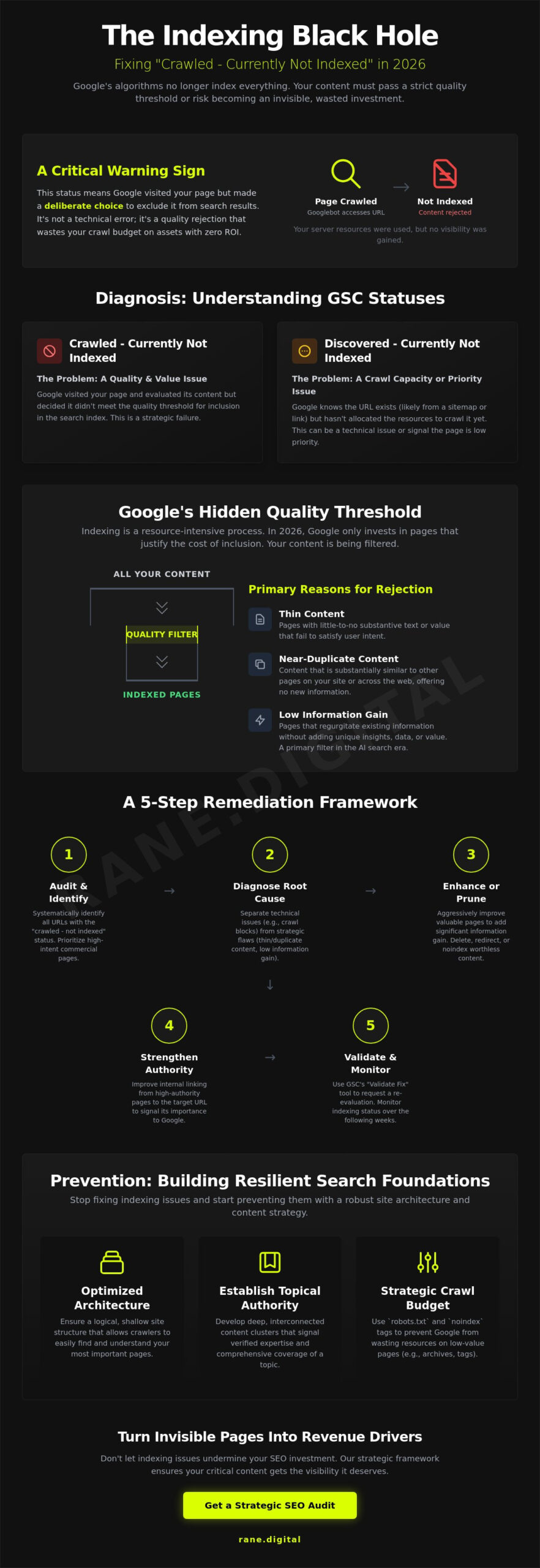
A 5-Step Remediation Plan to Force Indexing
Passive waiting is a luxury that high-performance brands cannot afford. If your pages are stuck in the crawled – currently not indexed status, simply resubmitting the URL is rarely effective. You need to provide a definitive signal that the content has undergone a material transformation. A proactive remediation plan focuses on high-intent pages that directly contribute to revenue, ensuring that Google’s limited indexing resources are allocated to your most valuable assets. By fixing the underlying architecture, you move beyond superficial fixes to create a sustainable search presence.
Step 1: Audit and Prune Low-Value Content
Effective remediation begins with a ruthless assessment of your existing URL list. Identify every page currently carrying this status and decide if they should be improved, redirected, or deleted. If a page serves no unique purpose, it creates crawl bloat that distracts Googlebot from your priority content. Consolidate multiple thin or overlapping pages into a single, high-authority pillar page that satisfies a broad range of user intent. This reduction in volume often leads to a higher indexing rate for the remaining, superior assets.
Step 2: Enhance Information Gain and Authority
Google requires a reason to change its mind about your page’s value. To overcome the crawled – currently not indexed barrier, you must inject unique information gain that wasn’t present during the previous crawl. Add original data points, expert quotes, or proprietary case studies that differentiate your content from generic competitors. Ensure the publishing date reflects and that the copy provides a direct, comprehensive answer to the primary search intent. This isn’t just about length; it’s about the density of original insight.
Step 3: Optimize Internal Linking and Site Architecture
Google uses internal links as a primary indicator of page importance. To force a re-evaluation, add at least 3 to 5 internal links from high-authority, already-indexed pages directly to the unindexed URL. This transfers authority and provides a fresh discovery path for the crawler. Simultaneously, audit your XML sitemap to ensure it contains only ‘200 OK’ indexable pages — understanding what is a sitemap XML and how it functions as a structural declaration for AI agents is essential for ensuring your most valuable pages are correctly surfaced. Review your SEO foundations to ensure logical URL nesting, as deep or convoluted hierarchies often lead to indexing gaps.
Step 4: Build External Authority Signals
External validation acts as a powerful catalyst for indexing. When high-authority domains link to your unindexed content, it signals to Google that the page is a recognized resource within your niche. This can be achieved through targeted digital PR or strategic content distribution. These external signals often bypass the standard quality filters that trap new pages in the crawl-only phase.
Step 5: Monitor and Validate in GSC
Finalize the process by using the URL Inspection tool to request a re-crawl only after all improvements are live. Monitor the Page Indexing report over the following 14 days to track the transition from excluded to indexed. If the status persists, it indicates that the information gain or authority signals are still below the required threshold for your specific vertical. For a deeper analysis of your site’s indexing health, you can book a strategic consultation to align your technical assets with commercial demand.
Search Foundations: Protecting Your Site from Future Indexing Gaps
Proactive management of your site’s search foundations is the only way to avoid the recurring frustration of the crawled – currently not indexed status. It’s far more cost-effective to prevent these gaps during the planning phase than to remediate them after a significant traffic drop. A robust site structure serves as the cornerstone of AI Visibility, ensuring that every crawl translates into a searchable asset. By treating your technical health as a continuous process rather than a one-time fix, you protect your content budget and maintain a stable path to revenue. Regular monitoring of your Google Search Console Indexing reports allows for the early detection of crawl budget waste before it impacts your bottom line.
The Role of Demand Mapping in Indexing
Aligning your content strategy with real search demand is the most effective way to ensure Google views your pages as necessary rather than optional. When you employ Demand Capture strategies, you move away from creating content for the sake of volume and focus on satisfying specific user needs. Every URL on your site must be mapped to a clear commercial outcome to justify its place in the index. If a page doesn’t serve a distinct stage in the buyer’s journey, it becomes an easy target for exclusion. RANE Digital prioritizes this alignment to ensure your site remains lean, authoritative, and free from the bloat that triggers indexing filters. This strategic clarity ensures that every page is a strategic asset, not just a placeholder.
Building a Scalable AI Visibility Strategy
A scalable strategy requires the integration of AI-driven audits to catch near-duplicate content and structural errors before they go live. By focusing on Authority Building, you effectively lower the quality threshold Google applies to your site, making it easier for new pages to earn immediate indexing. Partnering with specialized engine optimization services ensures that your technical health and commercial performance work in tandem. This proactive approach prevents the crawled – currently not indexed error from throttling your growth. We build every page as a strategic asset, ensuring that your foundation is resilient enough to handle the evolving demands of modern search engines. Consistency in your technical standards is the only way to maintain visibility in an increasingly selective search landscape.
Take Control of Your Search Performance
You can’t afford to let technical friction or strategic misalignment dictate your market share. Taking control of your search performance requires a shift from reactive troubleshooting to the intentional design of your site’s architecture. Consult with a strategic partner to identify and fix the underlying flaws in your foundation. Book a strategic consultation to resolve your indexing challenges and ensure your content drives the visibility your business deserves. Stop settling for invisible pages and start treating your search presence as the high-value commercial engine it’s meant to be. Precision and intent are the only ways to win today.
Dominating the Index with Strategic Intent
Google’s indexing model treats your site’s storage space as a calculated investment. If your pages remain trapped in the crawled – currently not indexed status, the solution isn’t higher content volume; it’s higher content clarity. You’ve seen that resolving these gaps requires a decisive shift from passive waiting to proactive remediation. By aligning your technical architecture with specific commercial intent, you ensure every URL serves a verifiable purpose within the search ecosystem. Success in this landscape belongs to brands that treat their search presence as a deliberate, data-backed asset rather than a collection of placeholders.
It’s time to stop letting technical friction and quality filters throttle your revenue potential. As traditional search evolves and AI-driven discovery reshapes how content is surfaced, investing in forward-looking engine optimization services is no longer optional for brands serious about maintaining organic market share. You can Fix your Search Foundations with RANE Digital using our specialized AI Visibility mapping and expert-led Demand Capture strategies. We provide the data-backed site structure remediation necessary to move your priority pages from GSC purgatory to high-visibility search results. Take control of your site’s future and build a foundation that scales alongside the rapid evolution of search. Your most valuable content deserves to be seen; we make sure it is.
Frequently Asked Questions
How long does it take for Google to fix ‘Crawled – currently not indexed’?
Google doesn’t operate on a fixed timeline for resolving this status; however, most sites see updates within 14 to 30 days after material content improvements are live. The search engine must first re-crawl the page to detect changes in quality or information gain before updating its index. Simply resubmitting a URL in Search Console without making updates often results in no change. You should focus on enhancing page value before expecting a status shift in your reports.
Does ‘Crawled – currently not indexed’ mean my site is penalized?
This status is not a manual penalty or an algorithmic demotion; it is a resource allocation decision based on perceived value. Google has successfully accessed your URL but decided that indexing it wouldn’t improve the quality of its search results. While it isn’t a “red flag” for your entire domain, it does signal that specific pages aren’t meeting the necessary quality threshold for inclusion. Addressing these gaps is a matter of strategic refinement rather than penalty recovery.
Can high-quality content still be ‘Crawled – currently not indexed’?
High-quality content can still be categorized as crawled – currently not indexed if it lacks unique information gain or sufficient internal authority. Google evaluates content not just on prose quality, but on how it differentiates itself from existing indexed pages. Even well-written articles may be excluded if they are buried deep in your site’s architecture or if your domain hasn’t established the topical authority required to support that specific subject matter.
Is there a limit to how many pages Google will index on my site?
Google does not impose a hard numerical limit on indexed pages, but it does operate with a finite crawl budget for every domain. This budget is influenced by your site’s authority, server speed, and historical content quality. If you produce thousands of low-value URLs, Google will eventually stop indexing new pages to protect its resources. Strategic site architecture ensures your most commercially critical pages are prioritized within these natural resource constraints.
How do I use the Indexing API to fix this issue?
The Google Indexing API is specifically designed for pages containing JobPosting or BroadcastEvent structured data and shouldn’t be used for standard articles or product pages. Using the API for general content types is often ineffective and can lead to quota issues. For most content, the correct approach involves improving internal linking and information gain to naturally attract Googlebot. Relying on the API for standard SEO is a tactical error that ignores the underlying quality issue.
What is the difference between ‘Discovered’ and ‘Crawled’ in Search Console?
The primary difference is the level of interaction Googlebot has had with your URL. “Discovered” indicates that Google knows the page exists but hasn’t visited it yet, often due to crawl budget limitations or low priority. “Crawled” means Google has successfully visited and read the page code but chose not to add it to the index. Understanding this distinction helps you decide whether to fix your site’s technical “plumbing” or its broader content strategy.
Will adding more backlinks help get my pages indexed?
Strategic backlinks can significantly improve indexing rates by signaling to Google that your content is an authoritative resource worth storing. When reputable domains link to your unindexed pages, it provides a vote of confidence that can bypass standard quality filters. However, backlinks shouldn’t be used to mask poor content. The most effective approach is to combine external authority building with internal remediation to ensure your crawled – currently not indexed pages earn long-term visibility.
Should I delete pages that are ‘Crawled – currently not indexed’?
You should only delete pages if they serve no commercial purpose and provide zero value to your audience. In many cases, a better strategy is to consolidate multiple thin pages into a single high-authority pillar page that targets a broader intent. Deleting pages indiscriminately can lead to broken internal links and a loss of historical data. Always evaluate whether a page can be improved or redirected before choosing to remove it from your ecosystem entirely.
Disclaimer
The information provided on this blog is for general informational and educational purposes only. While we strive to provide accurate and up-to-date content, the opinions and insights expressed here represent our best marketing judgments and should not be taken as professional, legal, or financial advice. Any reference to third-party websites or external links is provided for convenience and does not imply endorsement; we are not responsible for their content or accuracy. Digital marketing results vary based on individual effort, budget, and market conditions; we make no guarantees or warranties regarding specific outcomes or performance metrics resulting from the use of this information.