

Most keyword research is a graveyard of unused data that fails to drive business value. You’ve likely spent weeks identifying high-volume terms, only to watch your pages compete against each other or fail to rank for the right intent. It’s a common frustration to see internal pages cannibalising your own search presence while your marketing budget evaporates into content that doesn’t convert. Effective keyword mapping solves this by transforming raw data into a deliberate, high-performance site architecture that captures revenue-driving intent.
This guide provides a blueprint for building a search foundation that thrives in the era of AI-driven results. You’ll learn how to eliminate structural friction, prevent keyword overlap, and create a roadmap for content that aligns with how modern search engines evaluate authority. We’ll explore how to move beyond simple lists to develop a strategic framework that ensures every page on your site has a distinct purpose and a clear path to commercial success. By the end, you’ll have the tools to turn search data into a long-term visibility asset.
Key Takeaways
- Learn how to align specific search intent with your site hierarchy to ensure every URL serves a distinct commercial purpose.
- Understand the transition from exact-match lists to entity-based demand mapping to secure long-term visibility in AI-driven search results.
- Identify and resolve structural friction points like keyword cannibalisation and crawl budget waste that undermine your search foundations.
- Implement a strategic keyword mapping framework that organises content into pillar and cluster structures to build undeniable topical authority.
- Transform static spreadsheets into a dynamic commercial intelligence asset that adapts to shifting market trends and evolving searcher behaviour.
What is Keyword Mapping in the Age of AI Visibility?
Keyword mapping is the strategic process of assigning specific search intents to unique URLs within a site hierarchy to ensure every page serves a distinct commercial purpose. This practice serves as the architectural blueprint for your entire Search engine optimization (SEO) strategy. It transforms a collection of isolated pages into a cohesive authority engine. Today, the definition has shifted. We no longer map strings of text; we map entities and commercial demand. With 68% of online experiences starting with a search engine, your ability to provide a clear path for crawlers and AI agents determines your overall market share. Google still holds 92.58% of the search market, but its transition to a holistic scoring system for performance and AI integration means your mapping must be more precise than ever.
Strategic mapping is the primary tool for achieving AI Visibility. It provides the semantic clarity that allows search engines to understand the depth and breadth of your expertise. When you map keywords correctly, you create a network of related topics that signal topical authority. This isn’t about repeating a phrase five times on a page. It’s about demonstrating that your site is the most credible source for a specific cluster of information. A well-executed map ensures that your internal linking and content production work in harmony to build a resilient search presence.
The Evolution from Keywords to Intent Clusters
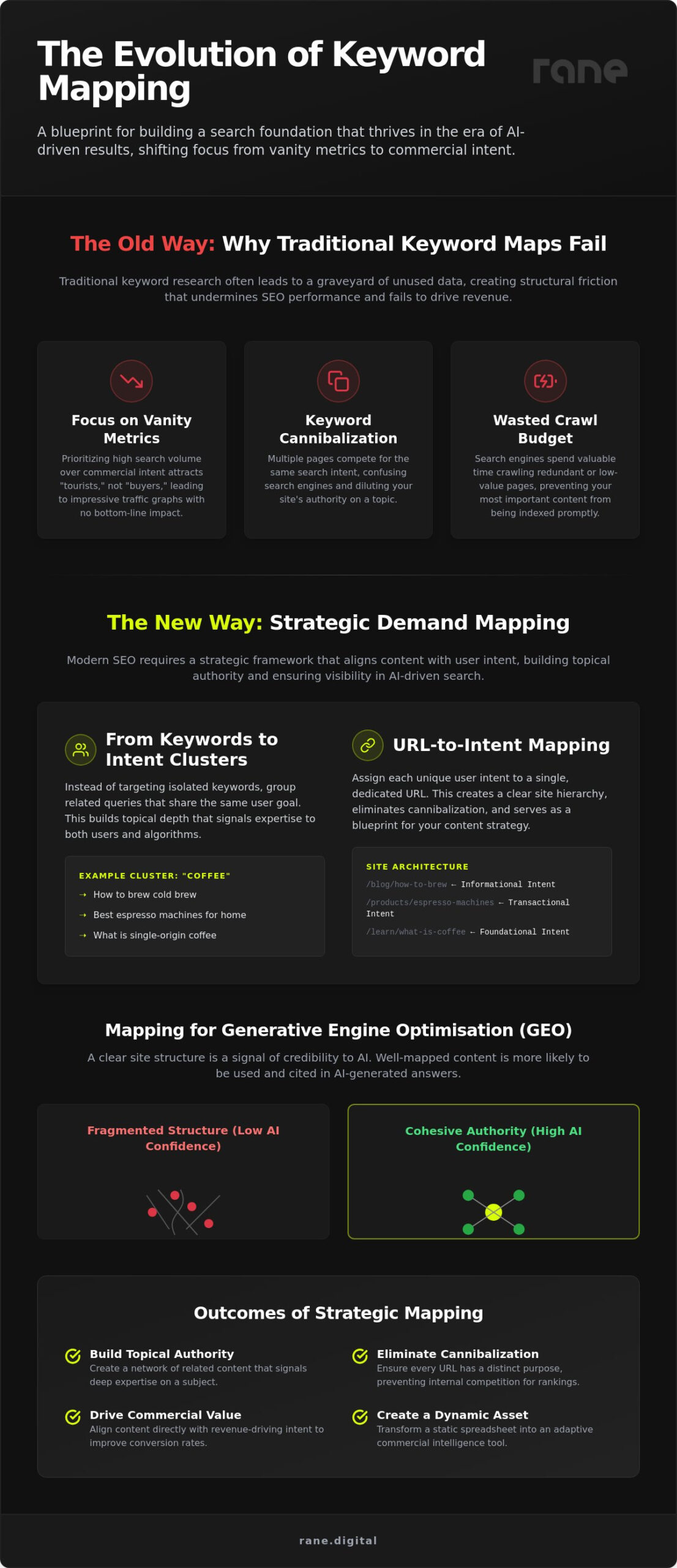
Modern search engines group keywords into broader topics because they prioritise the underlying user intent over exact linguistic matches. These “Intent Clusters” represent the semantic relationship between different queries that share the same goal. Traditional keyword lists are static and narrow, often leading to content that feels repetitive or thin. Intent clusters are dynamic. They allow you to build topical depth that signals expertise to both users and algorithms. AI now interprets the “hidden” intent behind complex, long-tail searches with high precision, looking for pages that provide comprehensive solutions. This shift requires a move toward search demand mapping, where content is built to satisfy a topical ecosystem. By clustering intent, you avoid the trap of creating multiple pages for the same purpose.
The Role of Mapping in Generative Engine Optimisation
Keyword mapping establishes the clear URL-to-topic associations that generative engines like Gemini or Perplexity use to verify your brand’s expertise. If your site structure is fragmented, AI agents cannot confidently attribute specific knowledge to your domain. Clear mapping acts as a functional signal of credibility. It ensures that when an AI generates an answer, your page is the logical choice for a citation. Disorganised sites often fail to appear in AI-generated summaries because the relationship between their pages is too opaque for a machine to parse efficiently. You don’t want your best insights buried in a flat structure. Winning in the era of Generative Engine Optimisation (GEO) requires an architecture that explicitly tells AI what you are an authority on. This level of clarity is only possible through a rigorous mapping process that eliminates ambiguity.
Why Traditional Keyword Maps Fail to Drive Revenue
Traditional keyword mapping fails to drive revenue because it prioritises vanity metrics like search volume over commercial intent. Most SEO strategies treat a spreadsheet as a finished product, yet they ignore the commercial reality of the terms they’ve selected. Mapping keywords based on monthly search volume rather than buyer intent is a frequent error that populates your site with “tourists” rather than “buyers.” This approach creates an impressive traffic graph that doesn’t impact the bottom line. It’s an informational trap where you rank for high-volume terms that never convert because the user isn’t looking to solve a commercial problem.
Poorly executed maps create significant friction within your SEO foundations. When you lack a clear URL-to-intent association, search engines struggle to identify your most authoritative page. This confusion forces crawlers to revisit multiple similar URLs, wasting your crawl budget on redundant content. It’s a structural leak. It prevents your strongest assets from receiving the attention they deserve while inflating your hosting and maintenance costs. You’re effectively paying to confuse your most important visitor: the search engine crawler.
Identifying and Fixing Keyword Cannibalisation
Cannibalisation is a conflict of intent, not just a repetition of words. It occurs when search engines can’t distinguish which URL is the definitive answer for a specific query, causing your pages to compete against each other. This dilution of authority splits your click-through rate and often results in the wrong page ranking for a high-value term. To resolve this, you must identify which page has the highest commercial potential for that specific cluster. Consolidate weaker, overlapping pages using 301 redirects or use canonical tags to point authority toward the primary URL. This cleanup ensures your map remains lean and strategically aligned.
The Disconnect Between Search Volume and Commercial Value
High search volume is often a distraction from actual commercial value. A page that attracts 100 visitors with specific, high-intent queries is infinitely more valuable than a general guide bringing in 10,000 top-of-funnel readers. You must assign a commercial priority score to every term in your Keyword Mapping for SEO. This scoring system helps you focus resources on capturing high-intent traffic that actually converts into revenue. If you’re struggling to bridge the gap between traffic and sales, it might be time to audit your strategic partnerure to ensure your content matches the buyer’s journey.
The Demand Mapping Framework: Aligning Intent with Site Architecture
Demand Mapping is the strategic blueprint that converts raw search data into a functional site architecture. It moves beyond the limitations of traditional keyword mapping by treating your website as a structured knowledge graph rather than a collection of isolated pages. Instead of looking at keywords in isolation, this framework views them as interconnected nodes that define your brand’s expertise. This approach ensures every piece of content has a logical place within your hierarchy, preventing the structural fragmentation that often plagues growing sites. By aligning search intent with a rigid site structure, you create a seamless experience for both users and search engines while reinforcing your domain’s topical authority.
This framework dictates your internal linking strategy by establishing clear pathways between related topics. When your mapping is precise, internal links act as high-value signals that tell search engines exactly which pages are the most authoritative for a given subject. It’s an architectural necessity. Without this alignment, your internal links are just random connections that fail to pass semantic value or guide the user toward a commercial resolution. A well-mapped site uses its structure to prove its depth, making it significantly easier to rank for competitive terms.
Pillar Pages vs. Supporting Content
Pillar pages serve as the primary authority anchors within a keyword map, addressing broad search intents with comprehensive, high-level overviews. These pages act as the “hub” for a specific topic, while supporting content (the “spokes”) dives into granular details that reinforce the pillar’s credibility. This hierarchy signals to AI-driven search engines that your site possesses both breadth and depth in a specific niche. Supporting assets typically target H3 or H4 level queries, answering specific questions that lead users back to the primary pillar. The following table illustrates how to differentiate these strategies across your map.
| Strategy | Intent Level | Content Type | Primary Goal |
|---|---|---|---|
| Pillar | Broad / Informational | Comprehensive Guide | Topical Authority |
| Cluster | Specific / Commercial | Solution Articles | Intent Capture |
| Long-tail | Granular / Transactional | Product or FAQ Pages | Lead Conversion |
Mapping for the Modern Buyer Journey
Mapping content to the buyer journey requires a deliberate alignment of search queries with the specific stage of a user’s decision-making process. Top-of-funnel (TOFU) “Problem” keywords should map to educational guides that establish trust without a hard sell. Middle-of-funnel (MOFU) “Solution” keywords are better suited for comparison pages or case studies that evaluate different approaches. Finally, bottom-of-funnel (BOFU) transactional terms must map directly to high-conversion landing pages where the user can take immediate action. For those in complex software niches, specialised SaaS SEO mapping strategies are essential to manage the nuanced intent of technical buyers. Ensuring this alignment prevents you from sending a ready-to-buy customer to a generic blog post.
How to Perform Strategic Keyword Mapping: A Step-by-Step Guide
Performing keyword mapping is a clinical exercise that replaces guesswork with architectural precision. It requires a deep dive into your existing data to identify where your site’s succeeding by accident and where it’s failing by design. By following a structured process, you can align your content with actual market demand and ensure every URL has a clear, profitable purpose. This isn’t a one-time task but a foundational shift in how you manage your digital authority.
Step 1: The Inventory and Audit
Start by exporting your performance data from Google Search Console to see what Google thinks your pages are about. This reveals the “accidental” mapping where pages rank for terms they weren’t intended for. Identifying these “unmapped” keywords is critical; these are terms driving traffic that lack a dedicated, high-authority home. View your site through a strategic partner’s lens to spot structural weaknesses where authority is spread too thin across multiple URLs. This audit creates the baseline for your structural transformation.
Step 2: Categorise Demand. Group your keywords based on Commercial Intelligence. This isn’t just about volume. It’s about identifying which terms signal a readiness to buy and which are purely educational. This stage sets the priority for your mapping efforts, ensuring you focus on the terms that move the needle for your business.
Step 3: Advanced Clustering Techniques
Modern keyword mapping relies on semantic relevance rather than just lexical similarity. Search engines group topics based on intent, meaning “keyword mapping” and “content architecture” might belong in the same cluster even without shared words. Use AI tools to handle this scale, especially when dealing with “hybrid intent” queries that blur the line between informational and commercial goals. RANE Digital maps demand and fixes site structure to ensure these complex clusters are handled with technical precision.
Step 4: Assign and Gap Analysis. Assign each cluster to a specific target URL. This process immediately highlights content gaps where high-intent demand exists but no page currently serves it. These gaps become your roadmap for future content production, allowing you to build authority in areas your competitors have overlooked.
Step 5: Technical Implementation. The final step involves executing technical fixes to codify your map. Use 301 redirects to consolidate redundant pages and canonical tags to point authority toward your primary assets. Update H-tags and metadata to explicitly reflect the mapped intent. If you want to transform your search presence into a high-performance asset, book a strategy call to discuss your custom site architecture.
Scaling Performance: From Keyword Maps to Commercial Intelligence
A static spreadsheet is a liability in a market where search intent shifts overnight. To drive sustained revenue, your keyword mapping must evolve into a living Commercial Intelligence asset that informs every level of your business strategy. This isn’t just about tracking rankings. It’s about maintaining a real-time record of how your audience’s needs are changing and where your competitors are gaining ground. By treating your map as a dynamic blueprint, you ensure your search foundation remains resilient against market volatility and technological shifts.
Continuous monitoring is essential to adapt the map as search trends fluctuate. When search engines evolve, they often reclassify the intent behind specific queries, which can render a previously successful mapping obsolete. We saw this clearly with the March Google Core Update, which fundamentally changed how holistic performance scores impact visibility. A proactive mapping strategy allows you to pivot before these updates degrade your traffic, turning potential threats into opportunities for market share expansion.
Turning Your Map into a Content Roadmap
Prioritising content production requires a clinical assessment of the intent gaps where your site currently lacks a dedicated authority home. Your map serves as the definitive briefing tool for writers, providing the exact semantic requirements and intent constraints needed to rank. It eliminates the risk of “accidental” content that serves no strategic purpose or, worse, competes with existing assets. This disciplined approach prevents cannibalisation at the source. It ensures that every new piece of content builds upon your existing authority rather than diluting it. You should audit and refresh this roadmap after every major algorithm shift to ensure your internal link architecture still points toward your highest-value commercial targets.
The Future: AI-Driven Demand Mapping
Predicting future search trends allows you to map high-intent demand before your competition even identifies the opportunity. As AI-driven search engines like Gemini and Perplexity become primary discovery tools, your mapping must account for how these agents synthesise information. RANE Digital integrates AI Visibility into the mapping process by identifying the entity-based relationships that these engines prioritise. This forward-thinking approach ensures your site isn’t just found; it’s cited as a primary authority. The connection between precise mapping, engine optimisation services, and revenue growth is undeniable. It’s the difference between passive traffic and a high-performance demand capture system. To build a site architecture that thrives in the next era of search, book a strategic consultation to develop your custom demand map.
Summary of Key Takeaways:
Keyword mapping is the architectural foundation of a revenue-driving search strategy. By aligning search intent with a rigid site hierarchy, you eliminate keyword cannibalisation and build the semantic depth required for AI visibility. This process transforms raw data into a strategic roadmap that guides content production and ensures long-term commercial success.
Securing Your Search Foundation for the AI Era
Transitioning from a spreadsheet-led approach to a strategic partnerure is the only way to safeguard your visibility as search engines become more integrated with AI. Effective keyword mapping ensures that every page on your site has a clear purpose. It eliminates the structural friction that leads to cannibalisation and wasted budget. By prioritising commercial intent over vanity metrics, you transform your digital presence into a high-performance asset that captures demand at the exact moment of need.
This architectural clarity is not a luxury. It’s a requirement for winning citations in generative search results. As search continues to evolve, your ability to provide a clean, semantic map of your expertise will define your long-term revenue growth. You don’t have to navigate this technical shift alone. Our team of AI-driven visibility experts and strategic partners are here to help you build a site structure designed for revenue-focused search performance. Build your strategic demand map with RANE Digital and take control of your market authority. It’s time to build a search presence that works as hard as your business does.
Frequently Asked Questions
What is the difference between keyword research and keyword mapping?
Keyword research is the process of identifying search terms your audience uses, while keyword mapping is the strategic assignment of those terms to specific URLs. Research identifies the market demand, but mapping provides the structural blueprint to capture that demand. It’s the difference between having a list of materials and having a finished architectural plan for a building.
How often should I update my keyword map?
You should audit your keyword map quarterly or immediately following a major Google core update. The search landscape shifts rapidly, as demonstrated by the multiple core updates in early 2026, meaning static maps quickly lose their competitive edge. Regular updates ensure your site architecture remains aligned with evolving user intent and new search features like AI Overviews.
Can one page be mapped to multiple keywords?
One page should be mapped to a single primary keyword and a cluster of semantically related secondary terms that share the same intent. This approach builds topical depth without diluting the page’s focus. You must ensure all mapped terms belong to the same intent cluster to prevent search engines from becoming confused about the page’s primary purpose.
How do I know if I have keyword cannibalisation issues?
Keyword cannibalisation occurs when multiple pages on your site compete for the same search query, often resulting in volatile rankings and split traffic. You can identify this by checking Google Search Console for instances where two or more URLs appear for the same keyword. If your impressions are divided between pages, your site lacks the clear intent mapping required for dominant visibility.
What tools are best for keyword mapping today?
Professional SEO platforms like Semrush and Ahrefs provide the most robust data for intent-based mapping. As of July 2026, Semrush offers its Guru plan for $249.95 per month, while Ahrefs’ Standard plan is priced at $249 per month. These tools allow you to cluster keywords by semantic relevance, which is essential for building a modern, AI-ready site architecture.
Does keyword mapping affect my site’s crawl budget?
Keyword mapping significantly improves crawl efficiency by eliminating redundant content and providing a logical internal link structure. When your mapping is precise, search engine crawlers don’t waste resources on duplicate pages or conflicting intents. This structural clarity ensures your crawl budget is focused on your most important, revenue-driving URLs.
How does keyword mapping improve AI search visibility?
Keyword mapping builds the clear URL-to-entity associations that AI agents like Gemini and Perplexity use to verify your expertise. By organising your content into distinct pillars and clusters, you make it easier for these engines to attribute specific knowledge to your domain. This semantic clarity increases the likelihood of your brand being cited as a primary source in AI-generated answers.
Should I map keywords to my homepage?
You should map your broadest, brand-centric terms to your homepage, as it serves as the ultimate authority anchor for your domain. High-level queries that describe your entire business model are best suited for this page. More specific commercial or informational queries should be mapped to dedicated landing pages to ensure the content matches the granular intent of the searcher.
Disclaimer
The information provided on this blog is for general informational and educational purposes only. While we strive to provide accurate and up-to-date content, the opinions and insights expressed here represent our best marketing judgments and should not be taken as professional, legal, or financial advice. Any reference to third-party websites or external links is provided for convenience and does not imply endorsement; we are not responsible for their content or accuracy. Digital marketing results vary based on individual effort, budget, and market conditions; we make no guarantees or warranties regarding specific outcomes or performance metrics resulting from the use of this information.
Want help with this? See our SEO services or book a discovery call.