

Most businesses treat their high-converting landing pages like secret documents, hiding them on unindexed subdomains where search engine crawlers never venture. This architectural choice creates a permanent reliance on paid media that erodes your margins. You shouldn’t have to choose between a clean, high-converting design and the organic visibility that drives long-term growth. Executing a sophisticated landing page seo strategy requires a shift from viewing content as clutter to seeing it as the essential infrastructure for commercial intent.
It’s frustrating to watch competitors dominate search results with inferior products simply because they’ve aligned their technical structure with the latest algorithm updates. We’ll show you how to master the structural and strategic requirements to build pages that dominate organic search without sacrificing conversion performance. This guide provides a clear framework for blending technical authority with conversion rate optimization; it ensures your most valuable commercial terms finally achieve the visibility they deserve.
Key Takeaways
- Shift your strategy from isolated PPC pages to search-accessible assets that align commercial intent with technical authority.
- Implement the “Trust Above, Depth Below” layout to satisfy human conversion needs while providing the semantic depth search engines require.
- Master landing page seo by migrating from subdomains to a subfolder hierarchy; this ensures your commercial pages inherit your domain’s full authority.
- Identify high-intent “Demand Clusters” to ensure your content remains visible across both traditional search results and emerging AI-driven platforms.
- Transition from tracking vanity rankings to measuring “Demand Capture” to ensure every organic visit translates into measurable revenue.
The Strategic Intersection: Defining SEO Landing Pages today
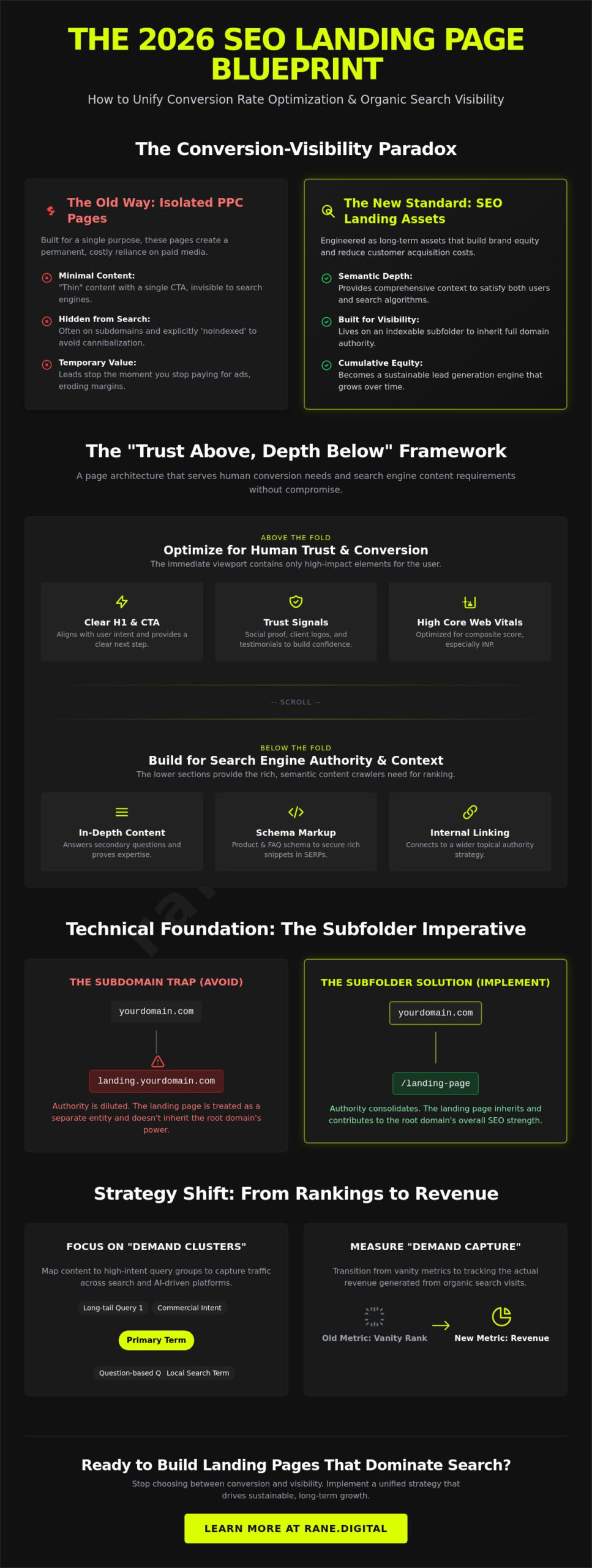
An SEO landing page is a high-authority digital asset engineered to satisfy specific user intent while maintaining the technical depth required by search engines. Today, successful landing page seo requires more than just a contact form and a catchy headline; it demands a structural alignment between commercial goals and search engine requirements. Many organizations fall into the “Conversion-Visibility Paradox,” where they create clean, minimalist pages for paid campaigns that are technically invisible to organic search. This happens because traditional paid media pages prioritize immediate conversion at the expense of the semantic depth and indexable content that Google and modern LLMs require for ranking.
strategic partnerure today moves away from traffic-first thinking toward an intent-first model. This means every page is built to be both human-persuasive and machine-readable. While a standard landing page might focus solely on a single call to action, an SEO-focused version provides the comprehensive context necessary to prove its relevance to a specific demand cluster. You aren’t just building a destination; you’re constructing a proof point for your brand’s expertise.
How do SEO and PPC landing pages differ in structure?
The primary difference lies in content depth and indexation rules, as “thin” pages with minimal text rarely rank today search results. PPC pages are often hidden from search engines via robots.txt or noindex tags to avoid keyword cannibalization with other internal pages. Organic landing pages, however, are built for longevity and must offer evergreen value. They require a robust content framework that addresses secondary questions and provides proof points. This satisfies the information gain criteria that search algorithms now prioritize to distinguish expert content from generic AI output.
Why are organic landing pages valuable for business growth?
Organic landing assets serve as a sustainable hedge against rising paid media costs by significantly reducing your long-term Customer Acquisition Cost (CAC). While PPC is a pay-to-play model that stops generating leads the moment the budget runs out, an optimized landing page builds cumulative brand equity over time. These pages don’t exist in a vacuum; they function as critical nodes in a wider topical authority SEO strategy. By capturing high-intent commercial traffic through organic search, you establish your brand as a credible leader in your vertical without the constant friction of auction-based bidding.
Anatomy of a High-Performance Landing Page for SEO
A high-performance landing page seo strategy treats the page layout as a functional hierarchy that serves two distinct audiences: the human visitor and the search crawler. We utilize the “Trust Above, Depth Below” framework to resolve the conflict between minimalist design and content requirements. This architectural approach places conversion triggers, trust signals, and clear H1 headings aligned with high-intent commercial queries in the immediate viewport. By reserving the lower sections of the page for the semantic depth search engines demand, you ensure the page remains rankable without cluttering the primary user experience.
Technical precision is a prerequisite for visibility in the current search environment. Following the March Core Update, Google now evaluates Core Web Vitals as a single, composite performance score rather than individual metrics. This shift makes INP (Interaction to Next Paint) a critical factor for both rankings and conversion; any perceptible delay in user interaction can degrade your performance score and suppress your visibility. Your URL structure must reflect this same level of clarity, using clean, keyword-rich paths that provide search engines with immediate context regarding the page’s commercial purpose.
On-Page Elements That Drive Visibility
Effective headings mirror the specific questions your target audience asks during their high-intent research phase. Instead of using H2 and H3 tags for generic labels, you should craft them to provide direct answers to the queries that drive your demand clusters. Integrating Product and FAQ schema markup further enhances this visibility by securing rich snippets that improve click-through rates. Even image alt-text serves a strategic purpose beyond accessibility; it acts as a signal for commercial intelligence, helping search engines categorize the intent and relevance of your visual assets.
Content Architecture for Conversion and Search
Every successful organic asset begins with a 100-word hook that earns the reader’s attention while establishing immediate relevance for search algorithms. This opening must balance persuasive sales copy with the informative depth required to satisfy modern E-E-A-T standards. You should treat social proof, such as client testimonials and case studies, as SEO entities that reinforce your brand’s credibility and authority within your niche. If your current pages aren’t meeting these structural benchmarks, it’s often necessary to refine your search foundations to ensure your architecture supports sustainable lead generation.
Demand Mapping: Aligning Landing Pages with AI Search and Intent
strategic partners don’t start with keywords; they start with demand mapping. This process involves identifying high-intent “Demand Clusters” before a single line of code is written. Today, targeting isolated keywords is an obsolete tactic that ignores how modern search engines group topics. When you align your architecture with specific clusters, you create a sustainable pipeline of high-intent traffic that competitors can’t easily disrupt. This alignment ensures that every asset you build serves a distinct commercial purpose within the customer journey.
Successful landing page seo now requires a clear distinction between awareness-based content and decision-oriented assets. While TOFU (Top of Funnel) pages build broad visibility, your SEO landing pages must focus on BOFU (Bottom of Funnel) intent to capture users ready to convert. By utilizing semantic keywords, you build a “moat” around your rankings. This depth of information proves to search algorithms that your page is the most authoritative answer for a specific commercial query, protecting your position from the volatility of minor algorithm shifts. For product-led businesses, our guide on SaaS SEO and AI visibility today demonstrates how to apply this demand-mapping approach to high-intent buyer journeys at scale.
Capturing High-Intent Commercial Traffic
Volume is often a vanity metric that distracts from actual revenue growth. We prioritize Commercial Intelligence over high-traffic keywords because capturing ten high-intent visitors is more valuable than attracting a thousand users with zero purchase intent. To determine the required content format, we analyze SERP features to see if Google favors comparison tables, video demonstrations, or long-form technical specifications. At RANE Digital, we map demand with surgical precision; this ensures every landing page has a documented revenue purpose and fits into a larger ecosystem of search foundations.
Optimising for the AI Search Era
The rise of generative engines like Perplexity and Google SGE has fundamentally changed how users interact with search results. To maintain visibility, your landing pages must be structured for easy extraction by these LLMs. This involves implementing “Entity SEO,” which focuses on establishing your brand as a recognized entity within your industry. By clearly defining the relationships between your products, services, and user problems, you increase the likelihood of being cited as a primary source in AI-generated summaries. For brands operating across multiple markets, working with an experienced global seo company that understands AI-driven demand patterns is essential for maintaining cross-border visibility. For a more comprehensive look at these emerging technologies, consult our guide on AI SEO today to understand how to future-proof your search performance.
Technical Foundations: Avoiding the Subdomain Trap and Orphan Pages
Choosing between a subfolder and a subdomain is the most critical technical decision in landing page seo. While subdomains are often easier for development teams to deploy, they frequently act as authority silos that fail to inherit the ranking power of your root domain. This structural choice often leads to “orphan pages” that struggle to gain visibility regardless of their content quality. A subfolder architecture ensures that every new commercial asset benefits from your existing search foundations, allowing you to launch campaigns with immediate technical momentum.
Managing the “plumbing” of your site also requires a sophisticated approach to A/B testing and sitemap management. You must use canonical tags to identify the master version of a page; this prevents search engines from flagging your split tests as duplicate content. Your XML sitemap should be dynamically updated to ensure that new campaign pages are discovered and crawled within hours, rather than days. Precision here ensures that technical friction doesn’t undermine your strategic intent.
Building Scalable Site Structures
Integrating standalone campaign pages into your site hierarchy requires a deliberate internal linking strategy that prevents them from sitting outside the crawl path. You should use descriptive anchor text from high-authority parent pages to pass equity to your new landing assets. This builds topical relevance and signals to search engines exactly what the page is designed to solve. If your current architecture feels fragmented, we recommend reviewing the RANE Digital process for structural alignment to ensure your pages are correctly positioned for growth.
Technical SEO for Landing Page Maintenance
Maintaining long-term performance for commercial assets involves active management of canonical tags and redirect patterns. When a seasonal campaign ends, you shouldn’t simply delete the page and trigger a 404 error; instead, implement a 301 redirect to the most relevant evergreen alternative to preserve any earned backlink equity. Monitoring Google Search Console for “Crawled – Currently Not Indexed” errors is also essential for high-value pages. This status often indicates that the search engine doesn’t perceive enough unique value in the content, requiring a strategic pivot in your content depth or entity alignment. To ensure your site architecture isn’t suppressing your commercial potential, you should audit your technical search foundations with a specialist team.
Measuring Success: Turning Search Performance into Revenue
Measuring the impact of landing page seo requires a move away from vanity metrics like keyword positions toward “Demand Capture” and direct revenue. While rankings provide a baseline for visibility, they don’t account for the commercial quality of the traffic being acquired. High-performance pages are successful only when they resolve the searcher’s intent and trigger a measurable business action. By focusing on conversion rates and lead quality, you transform search visibility into a predictable engine for growth that justifies the initial architectural investment.
Commercial Intelligence acts as the bridge between raw search data and strategic refinement. By analyzing which specific queries drive the highest lifetime value, you can adjust your landing page content to better align with the most profitable segments of your market. This creates a powerful feedback loop where search behavior informs your future product or service offerings. You aren’t just reacting to the market; you’re using real-time search intent to anticipate where your industry is heading.
Advanced Analytics for SEO Landing Pages
Sophisticated performance tracking goes beyond the last-click model to identify “Assisted Conversions” from organic search. In long-cycle B2B environments, a user might discover your landing page through an organic search query but convert weeks later via a direct visit or email. Heatmapping and user behavior analysis are essential for refining the depth of your content; these tools reveal if users are engaging with the technical information search engines require. Accurate attribution modeling ensures that the organic channel receives the credit it deserves for nurturing prospects through the decision-making process.
The Logical Conclusion: Integrating AI Visibility
The future of performance marketing lies in a deliberate blend of AI visibility, traditional SEO, and strategic paid search. As AI search matures, your landing page portfolio must be audited to ensure it satisfies both human conversion needs and the extraction requirements of generative engines. This integration is no longer optional for brands that intend to maintain their market share against more agile competitors. To begin this transition, you should book a strategy session to map your high-intent demand and align your architecture with the evolving search landscape.
Dominating high-intent search results requires a shift from superficial tactics to a rigorous, architecturally sound strategy. By aligning your technical foundations, demand mapping, and content depth, you create assets that serve both users and algorithms. This approach eliminates the reliance on expensive paid media while building long-term authority. The result is a high-performance search ecosystem that captures commercial intent and converts it into sustainable revenue.
Architecting for Sustainable Commercial Visibility
Dominating the search landscape today requires a departure from superficial tactics and a commitment to structural excellence. You’ve seen how a subfolder-first architecture and the “Trust Above, Depth Below” framework create the necessary foundation for high-intent visibility. By integrating Demand Mapping with AI-focused strategies, you ensure your assets remain discoverable across both traditional and generative search platforms. High-performance landing page seo isn’t a one-time project; it’s a deliberate alignment of technical precision and commercial intent.
To move beyond fragmented results, you need a partner who understands the intersection of data and growth. You can capture your high-intent traffic with RANE Digital’s AI Visibility services and leverage our strategic partner approach to dominate your vertical. We focus on building the search foundations that turn visibility into measurable revenue. Your most valuable commercial terms are waiting for a structural home that converts, and we’re ready to help you build it. Let’s transform your digital presence into a sustainable engine for growth.
Frequently Asked Questions
Is SEO worth it for landing pages used primarily for PPC?
Investing in landing page seo for PPC assets is highly effective because it builds long-term equity from your initial ad spend. Instead of relying solely on a pay-to-play model, you create a permanent asset that captures organic demand. This strategy reduces your average Customer Acquisition Cost over time. It ensures that your high-converting pages continue to generate leads even after you pause your paid campaigns.
How much content does an SEO landing page actually need to rank?
An SEO landing page needs enough content to comprehensively satisfy the searcher’s intent and provide semantic depth for crawlers. While word counts vary by industry, the page must cover the primary query and its related secondary questions. We recommend focusing on information gain by providing unique insights that aren’t found on generic competitor pages. This depth establishes your topical authority and improves your chances of being cited by generative search engines.
Can I use the same landing page for both SEO and Google Ads?
You can use the same page for both channels if you employ a strategic landing page seo framework that balances conversion and visibility. This involves keeping the top of the page clean and conversion-focused for paid traffic while placing detailed, indexable content lower down. It’s a sophisticated way to satisfy human users and search algorithms simultaneously. Just ensure your technical foundations, such as page speed and mobile responsiveness, meet the requirements for both channels.
Why is my landing page not showing up in Google search results?
Your landing page might be missing from search results due to technical blockers like noindex tags or a lack of internal authority. If the page is hosted on a subdomain or lacks internal links, search engines may classify it as an orphan page and deprioritize it. Check your Google Search Console to see if the URL is “Crawled; Currently Not Indexed.” This status often suggests that the content lacks sufficient unique value or technical relevance.
How do I handle A/B testing on a landing page I want to rank?
You should handle A/B testing by implementing canonical tags that point toward the original master version of the page. This tells search engines which URL is the primary source, preventing duplicate content issues during your experiment. It’s also important to use testing tools that don’t permanently redirect the user. This approach allows you to optimize for conversion rate without risking your organic search visibility or keyword rankings.
Should I put my landing pages on a subdomain or a subfolder for better SEO?
Subfolders are almost always the better choice for search performance because they inherit the authority and trust of your main domain. Subdomains are often treated by Google as separate websites, which means your campaign pages start with zero authority. By placing pages in a subfolder, you ensure they benefit from your existing search foundations. This structural choice leads to faster indexing and higher rankings for high-intent commercial terms.
What is the best way to build internal links to a new landing page?
The best way to build internal links is by using descriptive, keyword-rich anchor text from established, high-authority pages on your site. Don’t simply link from your homepage; find relevant blog posts or service pages that share a topical connection. This creates a logical hierarchy that search engines can follow easily. It passes link equity directly to your new commercial asset, signaling its importance within your overall site architecture.
How does AI-driven search affect how I should write landing page copy?
AI-driven search requires you to write copy that is highly structured and entity-focused so LLMs can easily extract your data. You should use clear headings and concise definitions to establish your brand as an authority on specific topics. Generative engines like Perplexity or Google SGE prioritize content that provides direct answers to complex user problems. Focusing on clarity and technical depth ensures your landing pages are cited as primary sources in AI-generated summaries.
Disclaimer
The information provided on this blog is for general informational and educational purposes only. While we strive to provide accurate and up-to-date content, the opinions and insights expressed here represent our best marketing judgments and should not be taken as professional, legal, or financial advice. Any reference to third-party websites or external links is provided for convenience and does not imply endorsement; we are not responsible for their content or accuracy. Digital marketing results vary based on individual effort, budget, and market conditions; we make no guarantees or warranties regarding specific outcomes or performance metrics resulting from the use of this information.
Want help with this? See our Google Ads and landing page work or book a discovery call.