

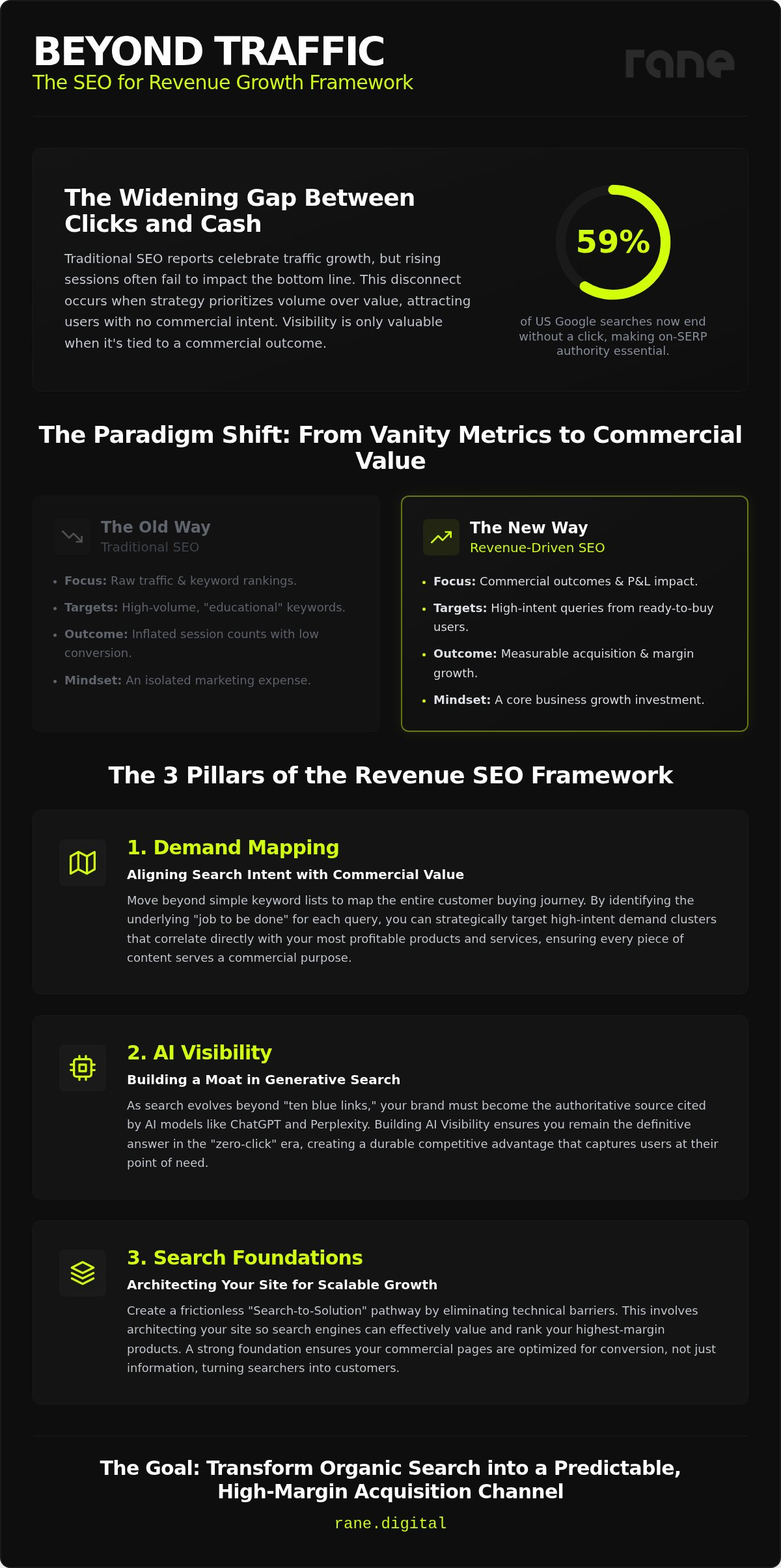
Nearly 59% of Google searches in the US now end without a click, yet most marketing reports still prioritize raw traffic volume as the ultimate sign of success. If your organic sessions are climbing while sales remain stagnant, you’re experiencing the widening gap between traditional search tactics and genuine business value. It’s a common frustration to see traffic growth that fails to move the needle, especially when you need to justify your budget to stakeholders who view SEO as an expense rather than a lever. We believe that visibility is only valuable when it’s tied to a commercial outcome, which is why a strategy focused on seo for revenue growth is now essential.
You’ll learn how to transform your organic presence into a predictable, high-margin revenue engine by leveraging demand mapping and AI visibility. We’ll explore how to dominate AI-driven search results in tools like Perplexity and ChatGPT, ensuring your brand remains authoritative as search behavior evolves. This framework moves beyond simple keyword rankings to align search intent with your most profitable products. By the end of this guide, you’ll have a clear roadmap for turning search data into commercial intelligence that drives measurable acquisition.
Key Takeaways
- Bridge the gap between traffic and sales by prioritizing commercial intent over vanity metrics in your seo for revenue growth framework.
- Capitalize on the “zero-click” era by building AI Visibility, ensuring LLMs like ChatGPT and Perplexity cite your brand as the authoritative solution.
- Uncover hidden conversion opportunities by mapping the specific “jobs to be done” across every stage of the customer buying journey.
- Eliminate technical friction points in your site architecture to ensure search engines can effectively value and rank your highest-margin products.
- Transform organic search into a predictable acquisition channel by aligning search foundations with deep commercial intelligence.
The Evolution from Vanity Metrics to Revenue-Focused Search
Traditional Search engine optimization (SEO) has historically been managed as a volume game. This approach prioritizes raw traffic numbers and ranking positions as the primary indicators of success. While these metrics look impressive in a monthly report, they often fail to correlate with actual business growth. A strategy built for seo for revenue growth requires a fundamental pivot. It’s the strategic alignment of organic search performance with a company’s bottom-line financial goals. This shift demands that we treat search not as an isolated marketing tactic, but as a core performance lever on the P&L.
Today, the digital environment has moved beyond the simple “ten blue links” model. Visibility is no longer enough. Your brand must be the definitive answer in both traditional search results and generative AI interfaces. If your content doesn’t directly address commercial intent, you’re essentially paying for traffic that will never convert. Moving from an expense-based mindset to a revenue-based one allows for better budget security and clearer strategic direction because the outcomes are tied to margin, not just impressions.
Why Traffic Volume is a Misleading Indicator of Success
High-volume keywords often attract “educational” searchers. These are users seeking definitions or general knowledge with no current intention of making a purchase. While they inflate your session count, they don’t contribute to your margin. Low-volume, high-intent queries frequently yield a significantly higher return on investment. They capture the user exactly when they are ready to solve a problem. When teams focus on vanity traffic, they create a dangerous disconnect with executive leadership. Boards don’t care about clicks; they care about customer acquisition costs and lifetime value.
The Role of Commercial Intelligence in Modern SEO
Commercial intelligence involves using search data to understand market demand and competitor positioning. It’s a shift from tactical keyword research to strategic market analysis. By analyzing search patterns, brands can identify “revenue gaps” where competitors are failing to satisfy high-intent users or where market needs are underserved. This data allows for a more targeted approach to commercial search intelligence and content production. Commercial intelligence is the bridge between search data and business strategy.
Demand Mapping: Aligning Search Intent with Commercial Value
Demand mapping is the strategic process of identifying every search touchpoint within a customer’s unique buying journey. It moves past the limitations of traditional keyword lists to uncover the underlying “job to be done” for each query. This approach ensures that your seo for revenue growth strategy isn’t just capturing eyeballs, but is actively engaging users who have a specific commercial need. Effective mapping reveals the critical gaps where your brand is currently invisible to high-intent buyers, allowing for a more surgical application of resources. RANE Digital utilizes demand mapping to ensure every piece of content serves a distinct commercial purpose within the wider sales ecosystem.
Identifying High-Intent Demand Clusters
Identifying high-intent demand clusters requires categorizing keywords by their specific funnel stage and commercial potential. We divide queries into informational, commercial, and transactional categories to understand where a user sits in their decision-making process. To maximize impact, we prioritize clusters that correlate directly with your highest-margin products or services. Validating these organic targets with existing PPC data provides a layer of commercial intelligence that confirms which terms actually drive dollars before you invest in long-term content production. This data-backed prioritization prevents wasted effort on high-volume terms that lack a clear path to purchase.
Bridging the Gap Between Search and Sales
Bridging the gap between search and sales involves mapping specific queries to landing pages optimized for conversion rather than just information. These pages must be architected to move a user from a state of inquiry to a state of action without unnecessary friction. By ensuring the “Search-to-Solution” path is logically structured, you build the necessary Search Foundations to retain and convert the traffic you attract. Analyzing competitor demand capture further identifies unserved niches where your brand can establish immediate dominance. If you’re looking to refine your own acquisition strategy, you might explore our strategic process for identifying these high-value revenue opportunities. This methodical alignment ensures that every search session has a measurable chance of contributing to the bottom line.
AI Visibility: Building a Competitive Moat in Generative Search
AI Visibility, or Answer Engine Optimization (AEO), is the capacity for your brand to be cited and recommended by Large Language Models like ChatGPT and Perplexity. Today, revenue is increasingly driven by “zero-click” answers where the AI acts as the primary recommender for the user. This shift represents a move away from the traditional click-through model toward a recommendation-first economy. Approximately 58.5% of Google searches in the US now end without a click, as users find answers directly within the interface. Building deep authority is the only way to ensure your brand remains the trusted source for these engines. You can explore RANE Digital’s approach to AI SEO to understand the mechanics of securing your position in generative results.
Traffic from AI search tools has grown by 527% year-over-year; it’s a critical frontier for any brand serious about seo for revenue growth. This isn’t just about traffic volume. Research indicates that visitors arriving from AI search tools are 4.4 times more valuable than traditional organic searchers. This is likely due to the higher level of intent and pre-qualification performed by the AI before it provides a recommendation. Securing this visibility requires a shift from keyword-centric content to entity-based authority building.
Generative Engine Optimisation (GEO) for Revenue
Generative Engine Optimization (GEO) focuses on making your content extractable by AI through clear claims, structured data, and authoritative citations. Unlike traditional search, AI engines value entity-based authority over simple keyword density. They look for established connections between your brand and specific solutions. Winning the “recommendation” in an AI chat is now the equivalent of ranking #1 on Google. It’s the ultimate validation of your commercial relevance. To win here, your content must provide direct, factual answers that the model can easily parse and credit back to your domain.
Turning AI Recommendations into Consistent Pipeline
Tracking referral traffic from AI platforms is essential to measure the direct impact of these recommendations on your signups and sales. You must create “source-worthy” content that models are specifically programmed to prioritize based on its factual accuracy and unique insights. This level of Executing the Revenue SEO Playbook through tech-enabled excellence is what separates market leaders from laggards. Authority building is a long-term revenue play. It protects your brand from the volatility of traditional algorithm updates by cementing your status as a primary source. Consistent visibility in these chats ensures your brand remains top-of-mind during the critical decision-making phase of the buyer journey.
Search Foundations: Architecting Your Site for Scalable Growth
Search foundations represent the technical and logical architecture that allows search engines to crawl and value your digital assets effectively. While many view site structure as a purely technical chore, it is actually a commercial imperative. A flawed site structure acts as a “revenue ceiling” that limits the impact of all other marketing efforts, regardless of content quality. For a strategy focused on seo for revenue growth, you must implement a hub-and-spoke model. This reinforces topical authority and ensures that your most valuable assets are never more than a few clicks from the homepage. Correcting your site structure is often the fastest way to unlock hidden organic revenue that is currently being suppressed by technical friction.
Scalability depends on clarity. When a site grows without a deliberate blueprint, it creates a “crawl maze” that confuses both users and search engines. This confusion leads to diluted authority and poor rankings for high-intent queries. A strategic partner approach ensures that every new page adds to the collective authority of the domain rather than competing with existing assets. By fixing these foundational issues, you transform a stagnant site into a dynamic asset that captures and retains high-margin demand.
The Commercial Impact of Site Architecture
Logical hierarchies are essential because they help search engines understand which pages are your “money pages.” When your site is organized intuitively, search bots can easily identify high-value transactional content. Proper URL structures and strategic internal linking distributions pass authority juice directly to your high-converting assets. This isn’t just about rankings. Fixing crawl budget issues ensures that your newest revenue-driving content is indexed and visible immediately, rather than languishing in a queue for weeks. An efficient architecture turns your site into a high-performance engine for customer acquisition.
Internal Linking as a Revenue Lever
Internal linking serves as a direct bridge between awareness and conversion. By linking from high-traffic educational posts to high-converting commercial pages, you guide users through a logical progression toward a purchase. You should use descriptive, intent-based anchor text to signal the specific value of the target page to both users and search engines. This practice helps search engines map the relationship between different topics and your core offerings. Automated internal linking audits are vital because they prevent “orphaned” revenue pages from being excluded from the crawl path. If you want to identify where your current architecture is leaking potential sales, you can request a search foundations audit to secure your growth trajectory.
Executing the Revenue SEO Playbook with RANE Digital
Executing a revenue-focused strategy isn’t a hands-off technical task; it’s a collaborative partnership. It requires deep alignment between SEO specialists and business stakeholders to ensure every search action supports a specific financial objective. This methodology prioritizes data that moves the needle on profit rather than just inflating traffic reports. RANE Digital provides the strategic performance necessary to turn search into a reliable revenue engine. By focusing on seo for revenue growth, we move away from the marketing expense silo and integrate search directly into your commercial excellence framework.
The process begins with a deep audit of your current demand capture and site foundations. We identify where your current organic presence is failing to convert and where technical friction is suppressing your margin. This grounded, results-oriented approach ensures that we aren’t just guessing. We’re building a roadmap based on the actual commercial intelligence of your market.
The strategic partner Approach
We operate as strategic partners who prioritize commercial substance over superficial metrics. Our team maps demand to identify untapped commercial opportunities in your niche, ensuring you don’t waste resources on low-value traffic. Once the gaps are identified, we fix site structure to ensure high-intent traffic reaches the right destination without friction. Finally, we build authority to establish your brand as the definitive leader in your industry. This three-pillared approach ensures your seo for revenue growth strategy is both defensible and highly profitable.
Measuring What Matters: The Revenue Dashboard
Success in modern search requires moving beyond keyword rankings to track metrics that actually impact the balance sheet. We help you implement a revenue dashboard that monitors Organic Revenue Per Session and total Pipeline Value. Our attribution models account for the multi-touch journey of an AI-driven searcher, capturing the value of visibility even when it doesn’t result in an immediate click. Review our latest case studies to see how we drive commercial results for our partners. This level of transparency ensures every dollar invested in search is a deliberate step toward scalable growth.
Transforming Search into a Commercial Engine
Transitioning from raw traffic to commercial intelligence ensures that every organic session contributes to the bottom line. By mapping demand to high-margin products and architecting site foundations for scalability, you remove the revenue ceiling that often limits traditional SEO. Dominating AI-driven search results is no longer optional; it’s the definitive way to protect your brand from algorithm volatility while capturing high-value recommendations. This framework turns organic search from a vanity channel into a predictable engine for customer acquisition.
RANE Digital operates as AI Visibility Specialists, utilizing a strategic partner Framework to deliver results-oriented performance. We help you move beyond stagnant reporting to achieve predictable growth in a multi-surface search environment. If you’re ready to implement a professional strategy for seo for revenue growth, the next step is to align your digital infrastructure with your financial goals. Book a Strategic Consultation to Scale Your Revenue and secure your position as an industry leader. Your path to a high-margin customer acquisition channel starts with strategic clarity.
Frequently Asked Questions
How long does it take for SEO to start generating revenue?
It typically takes 6 to 12 months for SaaS and healthcare brands to see meaningful revenue traction from organic search. For local businesses, this timeline is shorter, often between 4 and 6 months; however, enterprise-level campaigns may require 9 to 18 months for full maturation. These timelines reflect the period needed for search engines to validate authority and for high-intent content to capture a significant market share. We prioritize quick wins in site structure to accelerate this process where possible.
Is AI SEO different from traditional SEO for revenue growth?
AI SEO focuses on Generative Engine Optimization (GEO) to ensure Large Language Models cite your brand as a primary source. While traditional search relies on keyword-to-page matching, AI-driven seo for revenue growth prioritizes entity-based authority and factual extraction. This ensures your brand remains visible in “zero-click” environments like ChatGPT or Google’s AI Overviews. Users receive answers without visiting a website, making brand citations the new currency of search.
Can SEO genuinely replace paid search for customer acquisition?
SEO acts as a high-margin alternative to paid search by lowering your long-term customer acquisition costs (CAC). While PPC provides immediate visibility, it stops the moment the budget is exhausted. Organic search builds a compounding asset that captures demand without a per-click fee. A balanced strategy often uses PPC to validate demand mapping before transitioning those high-converting terms into long-term organic assets that drive profit indefinitely.
How do you measure the ROI of AI visibility and LLM citations?
Measuring the ROI of AI visibility involves tracking referral traffic from platforms like Perplexity and monitoring the conversion rates of those specific sessions. Research indicates that visitors arriving from AI search tools are 4.4 times more valuable than traditional organic searchers due to their high intent. By using advanced attribution models, you can link LLM citations directly to pipeline value and margin growth. This data allows for a clear view of how AI presence impacts the bottom line.
What is the most common mistake brands make with revenue-focused SEO?
The most frequent error is over-investing in high-volume “educational” keywords that attract users with no intention of purchasing. This creates a disconnect where traffic grows but sales remain stagnant. Brands must pivot their focus toward commercial intent and transactional clusters that align with their highest-margin products. Prioritizing volume over value leads to a marketing expense that fails to function as a genuine revenue lever on the P&L.
Do I need to change my site structure to rank in AI search engines?
Yes, a logical hub-and-spoke architecture is essential for AI engines to crawl and parse your site effectively. AI models prioritize content that’s structurally clear and supported by authoritative internal linking. If your site structure is fragmented, it acts as a revenue ceiling that prevents LLMs from recognizing your brand as a topical authority. Fixing these foundations ensures your high-intent content is easily extractable and cited by generative engines.
How does demand mapping differ from traditional keyword research?
Demand mapping goes beyond list-based keyword research to understand the specific “jobs to be done” at each stage of the buyer journey. Traditional research often ignores the underlying intent, focusing solely on monthly search volume. Mapping identifies every search touchpoint, allowing you to align your seo for revenue growth strategy with actual market needs. This ensures your content serves a specific commercial purpose within the sales funnel rather than just generating empty clicks.
What industries benefit most from a revenue-focused search strategy?
Industries with high customer lifetime value (LTV) or complex decision-making cycles, such as SaaS, healthcare, and enterprise technology, see the greatest return. These sectors rely on building trust and authority throughout a multi-touch journey. A revenue-focused approach ensures that search captures the user at the exact moment their intent shifts from inquiry to action. It transforms search into a predictable acquisition channel for high-margin services that require deep authority, a principle that niche specialists like aquaticseo.com apply specifically to the marine industry.
Disclaimer
The information provided on this blog is for general informational and educational purposes only. While we strive to provide accurate and up-to-date content, the opinions and insights expressed here represent our best marketing judgments and should not be taken as professional, legal, or financial advice. Any reference to third-party websites or external links is provided for convenience and does not imply endorsement; we are not responsible for their content or accuracy. Digital marketing results vary based on individual effort, budget, and market conditions; we make no guarantees or warranties regarding specific outcomes or performance metrics resulting from the use of this information.
Want help with this? See our SEO services or book a discovery call.