

Most performance marketing budgets are essentially subsidies for platforms that prioritize volume over value. You’ve likely felt the frustration of watching ad spend climb while attribution remains a black box of low-intent clicks. This friction occurs because many leaders treat it as a series of isolated tactics rather than a precision-engineered system. To truly understand what is performance marketing, you must view it as the strategic partnerure of demand capture. It’s not just about buying traffic. It’s about aligning your visibility with the specific intent of a buyer at the exact moment they are ready to act.
You know that the traditional playbook is failing in an era of AI-driven search and fragmented data. You need a framework that provides clarity instead of confusion. This guide will help you master the strategic framework required to capture high-intent demand while integrating your performance channels with genuine brand authority. We’ll examine how to build robust search foundations and use demand mapping to ensure your budget is never wasted on superficial metrics again.
Key Takeaways
- Define what is performance marketing as a strategic framework where payment is contingent on measurable outcomes. This shift moves financial risk away from your budget and toward proven results.
- Bridge the gap between brand authority and performance tactics. By doing so, you create a multiplier effect where established trust accelerates your conversion rates.
- Master the evolution of demand capture within an AI-driven search ecosystem. This ensures your visibility remains intact as the click economy changes.
- Implement a rigorous demand mapping process to identify high-value traffic. You must secure your search foundations before scaling spend to avoid wasting budget on a leaky bucket.
Defining Performance Marketing in a High-Intent Search Landscape
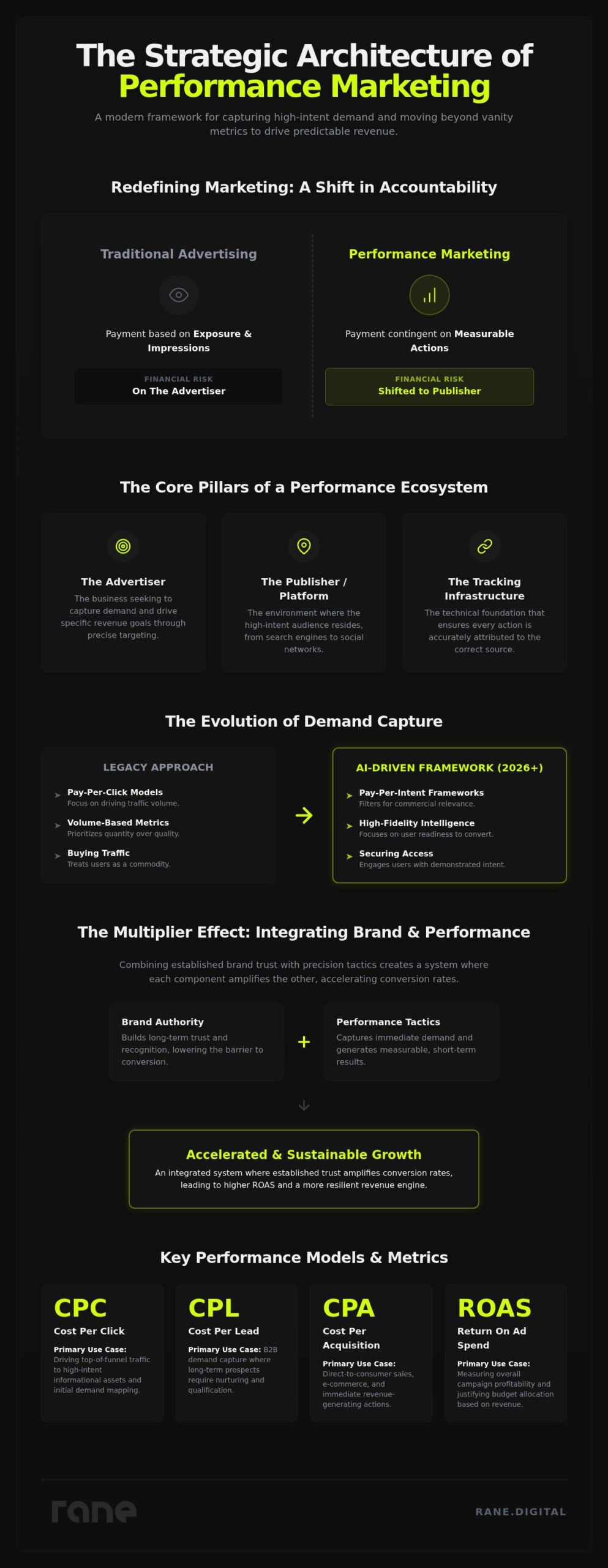
Performance marketing is a strategic approach to digital advertising where payments are contingent on specific, measurable user actions rather than broad exposure. This model fundamentally shifts financial risk from the advertiser to the service provider by prioritising tangible outcomes like leads or sales over passive impressions. In a high-intent search environment, Performance-based advertising ensures that every dollar spent is tied directly to a verifiable business result. Performance marketing is the intersection of data precision and commercial intent. Succeeding in this space today requires a deep understanding of AI-driven search intent and demand mapping to ensure you’re capturing the right audience at the right time.
To understand what is performance marketing in a professional context, you must look past the surface-level metrics and focus on the accountability it provides. It is an accountability framework. While traditional media buys force you to pay for potential eyeballs, this model requires proof of engagement. It turns the marketing department from a cost centre into a predictable revenue driver by ensuring that budget is only allocated to actions that move the needle.
Beyond the Click: The Evolution
Traditional pay-per-click models are rapidly evolving into pay-per-intent frameworks as AI filters out low-value traffic with increasing accuracy. This shift requires performance strategies to integrate seamlessly with AI SEO to create a holistic visibility engine. The focus has moved from volume-based metrics to high-fidelity commercial intelligence. You aren’t just buying traffic; you are securing access to users who’ve already signalled a readiness to convert through specific search behaviours. This evolution forces a pivot toward demand capture strategies that prioritise quality over quantity.
The Core Pillars of a Performance Ecosystem
A robust performance framework relies on three essential components working in total alignment to ensure every campaign remains efficient. Without these pillars, the strategic partnerure of your demand capture will fail to scale.
- The Advertiser: The business seeking to capture demand and drive specific revenue goals through precise targeting and clear commercial objectives.
- The Publisher/Platform: The environment where the high-intent audience resides, ranging from Google Search to emerging generative AI search engines.
- The Tracking Infrastructure: The technical foundation that ensures every action is accurately attributed to the correct source, providing the data needed for real-time optimisation.
Success in this landscape requires more than just launching campaigns. It demands a deep understanding of demand mapping to identify where high-value traffic actually originates. By building on solid search foundations, you ensure that your ad spend captures real intent rather than chasing vanity metrics that don’t result in revenue.
The Mechanics of Results-Driven Growth: Models and Metrics
The mechanics of performance marketing revolve around the alignment of incentives between the advertiser and the platform. When you understand what is performance marketing at its core, you see a system where pricing models dictate the level of risk and the focus of optimisation. Successful campaigns rely on granular data to adjust spend in real-time across multiple high-intent channels. This shift toward measurable accountability is why performance has become the new currency in advertising. Attribution modelling serves as the engine for this growth, determining which specific touchpoints contribute to the final conversion rather than just the last click.
| Metric | Strategic Definition | Primary Use Case |
|---|---|---|
| CPC | Cost Per Click | Driving traffic to high-intent informational assets and demand mapping. |
| CPL | Cost Per Lead | B2B demand capture where long-term prospects require nurturing. |
| CPA | Cost Per Acquisition | Direct-to-consumer sales and immediate revenue-generating actions. |
| ROAS | Return on Ad Spend | Holistic capital efficiency across all paid and AI-driven channels. |
Common Pricing Models: CPA, CPL, and Beyond
Pricing models are designed to reflect the commercial reality of your business goals. Cost Per Acquisition (CPA) focuses on the final sale, creating the most direct link between marketing spend and revenue. It’s the preferred model for high-volume transactions where margins are clearly defined. Conversely, Cost Per Lead (CPL) is essential for complex B2B cycles where demand mapping identifies long-term prospects who aren’t ready for an immediate purchase. For leaders looking at the broader picture, Return on Ad Spend (ROAS) provides a macro-view of capital deployment efficiency. It measures total revenue generated for every pound spent, allowing for strategic pivots based on overall profitability and commercial intelligence.
Tracking the Customer Journey in a Cookie-Less World
Maintaining visibility requires a shift in how data is collected and processed across the digital ecosystem. Server-side tracking has become the standard for maintaining data integrity Today, bypassing the limitations of browser-based cookies. This ensures that your attribution remains accurate even as privacy regulations tighten. First-party data has emerged as the primary asset for performance marketers. By owning the data relationship with your audience, you build a sustainable moat that competitors cannot easily replicate. Discover how our strategic process ensures every pound of spend is accounted for and optimised within this evolving technical landscape. This approach secures your search foundations before you scale, preventing the wasted spend associated with broken attribution models.
Performance vs Brand Marketing: Integrating Direct Response with Authority
The traditional divide between brand and performance is a false dichotomy that limits growth potential by forcing businesses into an unnecessary binary choice. In reality, these two disciplines function as a single, integrated visibility engine. Performance marketing captures demand, while brand marketing builds the authority that makes that capture cheaper. When you ask what is performance marketing in a mature commercial context, you must view it as the tactical execution of a broader authority strategy. High brand authority serves as a multiplier for performance marketing efficiency by increasing trust and click-through rates, ensuring that your high-intent traffic converts at a lower cost.
This synergy creates a feedback loop that benefits the entire business. Performance marketing provides the immediate data required to inform long-term brand positioning. It reveals which messages resonate with high-intent buyers, allowing you to refine your brand voice based on actual commercial performance rather than creative guesswork. By integrating these functions, you move away from isolated campaigns and toward a holistic system of revenue generation.
The Short-Term vs Long-Term Growth Paradox
Over-reliance on performance tactics often leads to “brand decay” if the underlying search foundations remain weak. You might see immediate returns, but without a long-term strategy, the cost to acquire each customer will inevitably rise as competition increases. Sustainable growth requires a strategic partner approach that balances immediate revenue with topical authority. This ensures that your brand isn’t just a temporary bidder for attention but a permanent fixture in the search landscape. Data from your performance campaigns is invaluable here. It identifies specific gaps in your brand’s authority mapping, showing you exactly where the market perceives a lack of expertise that you can then address through targeted content.
Why Performance Needs Authority to Scale
In an AI-search environment, the click economy is shifting toward trust and verified expertise. Users are significantly more likely to convert on ads from brands they already recognise as experts in their field. Authority building reduces friction in the conversion funnel, which leads directly to a higher ROAS. This isn’t just a psychological benefit; it has technical implications for your campaigns. For example, fixing site structure and search foundations improves ad quality scores, which lowers your CPA. Performance marketing provides the immediate data feedback loop that informs your long-term positioning. It tells you what the market wants right now, allowing your brand to adapt its messaging to meet that specific demand with precision.
The AI Visibility Shift: How Performance Marketing Evolves today
AI has transitioned from a functional add-on to the fundamental environment of digital commerce. Generative search engines are rapidly dismantling the traditional click economy, which necessitates a pivot toward AI-led PPC management strategies. When defining what is performance marketing in this new era, we must view it as the proactive management of AI-driven visibility. RANE Digital’s AI Visibility framework creates a sustainable moat by ensuring your brand is positioned as the authoritative answer within generative search results before a competitor even enters the auction. It’s about securing a position that legacy tactics simply cannot reach.
This evolution requires a total shift in how we perceive the search auction. You’re no longer just competing for a spot on a list; you’re competing to be the primary source of information for a neural network. Performance marketing now leverages predictive AI to identify demand before the competitor can bid on it, allowing for more efficient capital deployment. By integrating these advanced technologies into your search foundations, you ensure that your visibility is protected against the volatility of shifting algorithms.
How Does AI-Powered Search End Generic Traffic?
AI filters increasingly shield users from low-intent or irrelevant advertisements by prioritising contextual relevance over simple keyword matching. This shift makes precision more critical than ever. You must align your messaging with the specific, nuanced intent of the user. Commercial intelligence is the primary tool for navigating these results. It allows you to capture genuine demand rather than wasting budget on superficial interest that doesn’t result in revenue. The era of buying broad traffic and hoping for the best is over. Success now depends on your ability to map demand with surgical precision.
How Do Predictive Analytics Optimise Performance Spend?
Predictive AI identifies high-value demand cycles by using machine learning to forecast performance based on historical demand mapping data. This allows you to allocate budget with precision before your competitors even identify the opportunity. Modern bidding strategies have moved past simple cost-per-click metrics to prioritise lifetime value. This ensures your capital is invested in the customers who provide the greatest long-term return. AI visibility keeps your brand at the top of generative answers, turning search engines into a consistent source of high-intent revenue. Secure your competitive moat by partnering with us for AI Visibility services that turn emerging search trends into commercial advantages.
Building Your Performance Framework: From Demand Mapping to Revenue
A successful performance framework begins with understanding exactly where your high-intent audience is searching. You can’t scale effectively if your site structure is compromised. Search foundations must be finalised before you increase your spend to avoid the “leaky bucket” syndrome. This occurs when high-cost traffic arrives at a destination that isn’t technically or strategically prepared to facilitate a conversion. It’s a fundamental waste of capital that can be avoided through rigorous pre-launch auditing. When you internalise what is performance marketing at a strategic level, you realise it’s a cyclical process of mapping, capturing, and refining based on real-world commercial data. This methodical approach ensures that every pound of capital is deployed with maximum precision.
Implementing a high-performance system requires a structured progression. Follow these five essential steps to build a framework that captures demand and drives consistent revenue:
- Demand Mapping: Identifying the specific search environments and queries where your high-value audience lives.
- Search Foundations: Auditing and refining your technical infrastructure to ensure it can support and convert high-intent traffic.
- Intent-Aligned Channel Selection: Choosing the right mix of Paid Search, Social, and Native platforms based on user readiness.
- Attribution Infrastructure: Implementing server-side tracking to maintain data integrity in a cookie-less landscape.
- Performance Optimisation: Iterating your strategy based on commercial intelligence and real-time revenue data.
Mapping Demand to Capture Commercial Intent
Use demand mapping to pinpoint the specific queries that indicate a user is ready to make a purchase. Aligning your performance channels with the intent-stage of the user is the only way to maintain efficiency at scale. Generic traffic is the enemy of high-performance ROAS. It dilutes your data and inflates your acquisition costs without providing a corresponding increase in actual revenue. By focusing on high-fidelity intent, you ensure that your capture strategy is built on substance rather than superficial volume. This focus allows you to dominate the specific niches where your commercial value is highest.
Selecting a Performance Partner for AI Search
Look for agencies that prioritise AI visibility and search foundations rather than simple ad management. Ad management has become a commodity; strategic partnerure remains a rare competitive advantage. Transparency in data reporting and attribution modelling is non-negotiable for any serious growth partner. Choosing a partner who understands what is performance marketing in an AI-driven world is essential for maintaining a competitive moat. You need a team that understands how to navigate the shift toward generative search and predictive analytics. Ready to turn intent into revenue? Book a strategic consultation with RANE Digital today.
Mastering the Architecture of Demand Capture
Performance marketing has evolved from a simple bidding war into a complex exercise in commercial intelligence. You’ve seen that truly understanding what is performance marketing requires looking past the surface of clicks to the strategic partnerure of demand capture. Success in the current landscape demands a rigorous focus on search foundations and the integration of brand authority to lower your acquisition costs. As AI search continues to redefine the digital landscape, your competitive advantage will come from precision mapping and proactive visibility. It’s time to move beyond generic ad management and toward a system that treats every pound of spend as a deliberate investment in growth.
Secure your AI visibility and capture high-intent demand with RANE Digital to turn your search presence into a predictable revenue driver. By building on a Strategic AI Visibility framework and utilising expert demand mapping, you can navigate any market shift with confidence. Your path to scalable, results-oriented growth is now clearly defined.
Frequently Asked Questions
How is performance marketing different from traditional digital marketing?
Performance marketing distinguishes itself through a pay-for-results model where advertisers only pay when a specific, measurable action is completed. Traditional digital marketing often prioritises broad reach and impressions. This shift ensures that your capital is always tied to a tangible commercial outcome rather than superficial exposure.
Is performance marketing suitable for B2B companies with long sales cycles?
It’s highly effective for B2B environments when focused on capturing high-intent leads rather than immediate sales. By utilising a Cost Per Lead (CPL) model, you can identify and engage prospects at the moment they signal commercial intent. This allows your sales team to focus their efforts on qualified opportunities that have been vetted through precise demand mapping.
How does AI search affect performance marketing costs today?
AI search environments increase the cost of generic visibility while rewarding brands that possess deep topical authority. As generative engines filter out low-value traffic, competition for high-intent placements intensifies. To understand what is performance marketing in this era, you must view it as a battle for contextual relevance where efficiency is won through superior search foundations.
What are the biggest risks of relying solely on performance marketing?
The primary risk is brand decay, where a lack of long-term authority building causes your acquisition costs to rise over time. Relying exclusively on direct-response tactics can create a leaky bucket if your underlying brand trust isn’t maintained. A balanced approach ensures that your demand capture remains cost-effective by leveraging the multiplier effect of established credibility.
Can performance marketing work effectively without a massive ad budget?
Efficiency is more critical than volume in a results-driven framework. You don’t need a massive budget if your demand mapping is precise enough to target only the highest-intent segments of your market. By avoiding generic traffic and focusing on surgical demand capture, smaller budgets can often outperform larger, less disciplined spends.
How do I measure the success of a performance campaign beyond just clicks?
Success is measured through bottom-line metrics like Return on Ad Spend (ROAS), Cost Per Acquisition (CPA), and Customer Lifetime Value (LTV). Clicks are a secondary indicator of interest; revenue is the only primary metric that matters. Advanced attribution modelling allows you to see exactly which touchpoints contribute to your commercial goals.
What is the role of demand mapping in a performance marketing strategy?
Demand mapping acts as the strategic blueprint that identifies where your most valuable customers are searching and what they intend to find. It prevents wasted spend by ensuring your campaigns are only active in environments with high commercial potential. Without this mapping, your performance spend is essentially a series of uncoordinated guesses.
How do search foundations impact the ROI of my paid performance spend?
Robust search foundations directly lower your CPA by improving site performance and user experience. When your technical infrastructure is sound, platforms reward you with higher quality scores and lower bidding costs. This ensures that the traffic you pay for actually has a clear, frictionless path toward a final conversion.
Disclaimer
The information provided on this blog is for general informational and educational purposes only. While we strive to provide accurate and up-to-date content, the opinions and insights expressed here represent our best marketing judgments and should not be taken as professional, legal, or financial advice. Any reference to third-party websites or external links is provided for convenience and does not imply endorsement; we are not responsible for their content or accuracy. Digital marketing results vary based on individual effort, budget, and market conditions; we make no guarantees or warranties regarding specific outcomes or performance metrics resulting from the use of this information.