

With 78% of all Google Ads spend now managed by automated Smart Bidding strategies, the technical barriers to entry for performance marketing have effectively vanished. Success no longer depends on manual bid adjustments; yet, many businesses still find themselves wasting budgets on low-intent traffic and vanity metrics. Understanding how to choose a paid search agency in this automated environment requires a shift from looking for tactical executors to identifying strategic partners. You need a partner that does not just manage clicks but masters the intersection of commercial intelligence and AI visibility.
It is frustrating to watch ad spend climb while revenue remains stagnant, especially when agencies hide behind engagement data that does not impact your bottom line. We understand that you need clear visibility into how paid search feeds your wider business strategy and integrates with AI-driven SEO. This framework provides the exact criteria for vetting a partner capable of dominating AI Overviews and demand capture. We will examine the specific technical benchmarks and strategic questions that separate high-performance architects from generic service providers, ensuring your search spend drives consistent revenue rather than just noise.
Key Takeaways
- Transition from keyword bidding to intent-based demand capture to stop wasting budget on low-intent traffic.
- Differentiate between tactical executors and strategic partners who prioritize commercial intelligence over vanity metrics like clicks.
- Learn how to choose a paid search agency by evaluating their ability to align AI Visibility with your site’s search foundations.
- Use a structured vetting protocol to expose technical gaps and ensure your partner can navigate the complexities of AI-driven search.
- Prioritize partners that integrate paid search into a wider business strategy to drive consistent revenue growth.
Why does the modern search landscape demand a new agency model?
The transition from keyword-based bidding to intent-based demand capture has fundamentally changed how businesses must approach search performance. Success no longer depends on the volume of keywords managed but on how well an agency provides strategic inputs to automated systems. When deciding how to choose a paid search agency, you must look for partners that prioritize AI Visibility over simple ad placement. This shift marks the end of siloed performance marketing and the beginning of integrated commercial intelligence where every click must serve a specific business objective.
| Strategic Capability | Traditional PPC Vendor | Strategic Search Architect |
|---|---|---|
| Bidding Strategy | Manual or basic automation | Strategic Smart Bidding inputs |
| Primary Focus | Click volume and impressions | Intent-based demand capture |
| Integration | Standalone ad channel | Integrated with search foundations |
| Performance Metric | Vanity metrics (CTR/CPC) | Commercial revenue and visibility |
Why is tactical management insufficient for modern search?
Tactical management is insufficient because automated bidding has commoditized campaign execution, shifting the competitive advantage to data quality and strategic oversight. Technical execution is now a basic requirement rather than a differentiator. Traditional search advertising models often ignore how generative search features siphon off traditional ad real estate. Relying on an agency that treats PPC as a set and forget activity leads to inflated costs and wasted spend on low-intent traffic that lacks a clear path to conversion.
How does AI Visibility serve as the new performance benchmark?
AI Visibility serves as the new performance benchmark by measuring a brand’s presence within generative responses and AI-driven summaries. It moves beyond standard impression share to track how effectively your brand is cited as an authority by search algorithms. A strategic agency integrates this visibility with your SEO foundations to ensure your site structure provides the necessary context for AI matching. By focusing on this benchmark, you ensure that your paid search strategy is future proofed against the ongoing evolution of search platform behaviors.
The Evaluation Framework: Distinguishing strategic partners from Tactical Executors
Identifying the difference between a tactical executor and a strategic partner is the primary challenge for businesses learning how to choose a paid search agency. A tactical executor lives inside the Google Ads interface; they focus on micro-optimizations that the platform’s native AI already handles more efficiently. In contrast, a strategic partner looks outward at the broader business landscape. They prioritize the commercial value of traffic over the sheer volume of clicks, ensuring that every ad placement serves a specific business objective.
Demand Mapping vs. Keyword Research
Traditional keyword research is a relic of a manual-bidding era that focuses on search volume and competition scores rather than actual business intent. High-performance agencies replace this outdated method with a rigorous demand mapping process. This identifies specific clusters of search intent that correlate directly with your most profitable customer segments. By understanding the “why” behind the search, a strategic partner can identify high-intent clusters before spending a single dollar of your budget.
Demand Mapping is the strategic alignment of search intent with commercial revenue.
This approach ensures that your paid search strategy mirrors your organic authority building and prevents the common pitfall of capturing “cheap” traffic that never converts. Mapping demand across the entire funnel allows an agency to predict which search terms will drive long-term growth rather than temporary spikes in vanity metrics. It’s about capturing existing demand with precision while simultaneously identifying new opportunities for expansion.
Transparency and Account Ownership
Data transparency is the bedrock of a professional partnership and must include full client ownership of all ad accounts and tracking properties. You should never accept a “black box” arrangement where the agency retains administrative rights to your Google Ads or GA4 properties. If you don’t own your data, you don’t own your business intelligence. This lack of access makes it impossible to verify agency claims or pivot strategies if the relationship ends.
When deciding how to choose a paid search agency, vetting for transparency requires a deep dive into reporting structures. A tactical agency will often send a static PDF filled with metrics like impressions and click-through rates. A strategic partner provides a live, transparent dashboard that connects search spend to CRM data. This allows you to track commercial outcomes such as cost-per-acquisition and lead quality. Integrating AI-focused search strategies requires this level of data integrity to ensure the platform’s algorithms are learning from the right conversion signals rather than just raw traffic numbers.
Assessing Technical Maturity: AI Visibility and Performance Data Integrity
Technical maturity today is defined by an agency’s ability to provide the high-quality data inputs that AI-driven bidding algorithms require to function. When you evaluate how to choose a paid search agency, you must look beyond their ability to write ad copy. You need a partner that understands how site architecture and SEO foundations act as the prerequisite for paid search ROI. Without a fixed site structure, Google’s AI lacks the semantic context needed to match your ads with high-intent queries, leading to inefficient spend and inflated costs.
AI Visibility has become the critical benchmark for performance. It measures your brand’s presence within generative responses and AI-driven summaries that now occupy the most valuable search real estate. A modern paid strategy doesn’t just bid on keywords; it uses Generative Engine Optimization (GEO) to ensure your brand is the cited authority within AI answers. This technical alignment ensures your paid campaigns aren’t fighting against the search engine’s evolution but are instead leveraging it for greater commercial impact.
The Synergy of Paid Search and AI SEO
Paid search performance is no longer isolated from your organic presence. Your agency must have a deep understanding of AI SEO because organic authority building directly lowers the cost-per-acquisition for paid campaigns. When a brand is recognized as an authority by search algorithms, Quality Scores improve and ad placements become more cost-effective. A strategic partner uses paid search as a testing ground; they identify which intent clusters drive actual revenue and then use those insights to prioritize long-term organic dominance. This integrated approach prevents you from paying for traffic that you should already own through authority building.
Data Integrity and First-Party Signals
Algorithms are only as effective as the data they consume. Modern Smart Bidding relies on clean, first-party signals to distinguish between a casual browser and a serious commercial prospect. You should assess an agency’s proficiency with server-side tracking and CRM integration to ensure your data remains privacy-compliant and accurate. This technical setup allows the AI to optimize for “Commercial Intelligence” rather than just raw conversion counts. By feeding the algorithm data on lead quality and actual sales value, your agency transforms the ad account from a cost center into a predictable revenue engine. If an agency cannot articulate their process for maintaining data integrity in a privacy-first environment, they shouldn’t be managing your search spend.
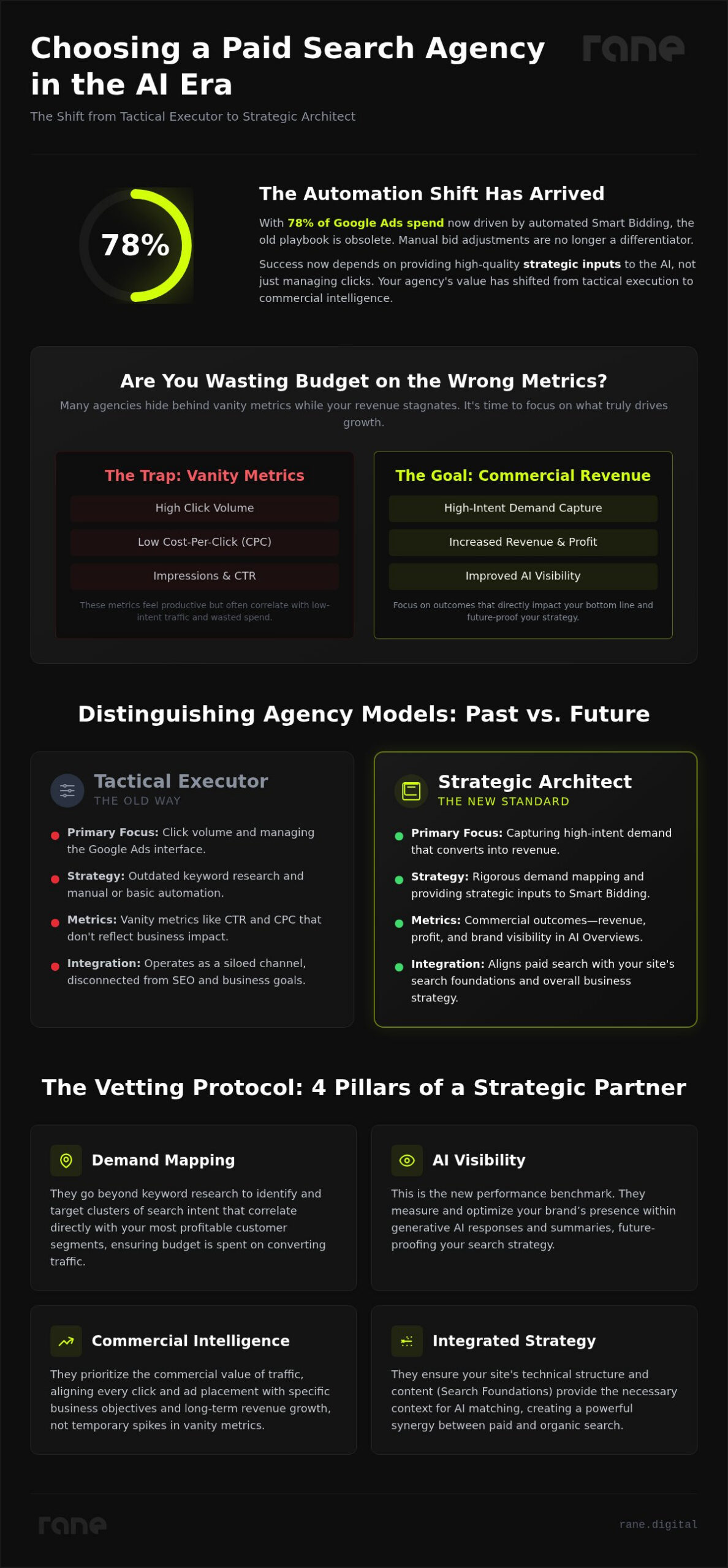
The Vetting Protocol: How to Interview for Commercial Intelligence
A rigorous interview protocol is the only way to bypass agency sales pitches and uncover the technical depth of a potential partner. When you evaluate how to choose a paid search agency, your focus must shift from surface-level metrics to the underlying systems that drive commercial outcomes. A tactical vendor will talk about click volume; a strategic partner will talk about demand capture and data integrity. This process ensures you select a partner capable of navigating the high-stakes environment of AI-driven search.
Five Critical Questions for Your Shortlist
Interviewing an agency requires asking questions that force them to explain their strategic logic rather than their tactical execution. These questions expose whether a team understands the modern search landscape or is simply repeating outdated PPC playbooks. Use these five queries to vet your shortlist:
- How do you map demand before building out a campaign structure? They should explain how they identify intent clusters that correlate with revenue rather than just search volume.
- Can you demonstrate how you integrate AI Visibility into our paid search strategy? Look for a clear plan on how they manage ad placements within AI Overviews and generative responses.
- What is your process for fixing site foundations to improve ad quality scores? A strategic partner won’t run ads to a broken site structure; they’ll insist on technical alignment first.
- How do you tie paid search performance directly to our CRM revenue data? Avoid agencies that can’t explain server-side tracking or offline conversion imports.
- Who owns the account and the data if the relationship ends? The only acceptable answer is that you maintain 100% ownership and administrative access.
Evaluating Case Studies and Proof Points
Effective case studies must demonstrate a clear link between ad spend and bottom-line revenue rather than just traffic growth. You should look for Case Studies that detail how an agency navigated complex demand mapping or improved a client’s AI Visibility. If a case study focuses purely on “increased clicks” without mentioning lead quality or commercial value, it’s a sign of a tactical model. You should also request a technical audit during the proposal phase. A high-performing agency won’t hesitate to analyze your current foundations to identify friction points that are currently inflating your acquisition costs.
Avoid “churn and burn” models characterized by high client-to-manager ratios and generic, automated reporting. Red flags include a lack of interest in your business margins, an obsession with vanity metrics, or a refusal to grant you full account transparency. These agencies prioritize their own efficiency over your long-term growth. Before signing a contract, you can book a strategic audit to verify if a potential partner has the commercial intelligence your business requires.
Strategic Alignment: Selecting a Partner for High-Intent Growth
Commercial alignment is the final filter in determining how to choose a paid search agency that acts as a growth engine rather than an overhead cost. It requires moving beyond the vendor mindset where tasks are outsourced in isolation. A strategic partner aligns their performance metrics with your actual business revenue, ensuring that every dollar spent on search captures high-intent demand. This alignment is only possible when the agency prioritizes Search Foundations and Demand Capture as the core of their operational model.
RANE Digital’s AI-focused search strategies represent the modern standard by treating search as a unified ecosystem. We move past the limitations of traditional PPC management to focus on how paid search feeds into your wider business strategy. By prioritizing technical site integrity and commercial intelligence, we ensure that your ad spend is an investment in scalable revenue. Selecting a partner who understands this relationship is the difference between temporary traffic spikes and long-term market dominance.
Why Integrated Visibility Wins
The competitive advantage in a generative search environment belongs to brands that treat search as a unified ecosystem. Combining a PPC strategy with AI SEO creates a feedback loop where paid data identifies profitable intent clusters and organic authority building lowers your overall acquisition costs. This integrated visibility ensures you aren’t just buying clicks; you’re building a defensible market position. Demand Mapping acts as the blueprint for this process, future-proofing your business against the inevitable shifts in search engine algorithms by focusing on human intent rather than just platform features.
Next Steps: Transitioning to a Performance-Led Model
Transitioning to this model begins with a discovery session designed to map your brand’s unique demand landscape. Before scaling any ad spend, a rigorous ‘Search Foundations’ audit is necessary to ensure your site structure can support the high-intent traffic you aim to capture. This phase identifies technical friction points that would otherwise dilute your ROI. You can discover how RANE Digital maps demand for high-growth brands by initiating a strategic review of your current search performance and technical maturity.
To finalize your decision, use this checklist to ensure commercial alignment:
- Does the agency’s reporting tie search spend directly to CRM revenue?
- Have they demonstrated a clear understanding of your specific commercial margins and unit economics?
- Is there a documented process for integrating paid data with SEO intelligence?
- Do they prioritize fixing site foundations before requesting budget increases?
- Is the relationship structured as a strategic partnership with full client data ownership?
Transitioning to a Strategic Growth Model
The search landscape has moved past the era of simple keyword management. Deciding how to choose a paid search agency now involves identifying a partner that functions as a strategic partner, capable of aligning your ad spend with technical site foundations and commercial intelligence. Success today relies on capturing high-intent demand through precise mapping rather than broad bidding. By prioritizing AI Visibility and data integrity, you transform your ad account into a predictable revenue engine that scales with your business goals.
RANE Digital is an AI-focused performance agency specializing in Demand Mapping and AI Visibility. We take a revenue-first approach to search foundations, ensuring your brand maintains a dominant position as search engines evolve. You can Book a Strategic Discovery Session with RANE Digital to audit your current strategy and identify untapped growth opportunities. Taking control of your data and intent mapping today secures your commercial advantage for the years ahead.
Frequently Asked Questions
What is the difference between a traditional PPC agency and an AI search agency?
Traditional PPC focuses on manual keyword bidding and ad copy. In contrast, an AI search agency like RANE Digital prioritizes AI Visibility and Demand Mapping. They provide strategic inputs to platform algorithms rather than fighting against automation. This includes fixing Search Foundations to ensure the AI understands the commercial context of your site. Understanding these distinctions is vital when learning how to choose a paid search agency in a performance-led market.
How much should I expect to pay for a high-quality paid search agency today?
Pricing models typically include a percentage of ad spend, flat-fee retainers, or hybrid models. While industry standards vary based on account complexity, high-performance partners prioritize commercial alignment over low-cost execution. You should expect to pay for strategic partnerure and demand capture expertise rather than simple account maintenance. Most reputable firms offer transparent fee structures that tie directly back to business growth and measurable revenue outcomes.
Can a paid search agency help with my organic SEO strategy?
A strategic agency uses paid search data to inform your organic authority building. By identifying which intent clusters drive the most revenue through ads, they can prioritize SEO efforts for maximum commercial impact. This integrated approach ensures that your Search Foundations support both paid and organic visibility. It prevents siloed strategies that waste budget on redundant traffic and ensures your brand dominates the entire search ecosystem.
What are the biggest red flags when hiring a performance marketing agency?
The most significant red flags include a lack of account ownership, “black box” reporting, and an obsession with vanity metrics like clicks over revenue. If an agency refuses to grant you full administrative access to your Google Ads account, they’re likely hiding tactical inefficiencies. Another warning sign is a refusal to discuss site structure or technical foundations before launching campaigns. These behaviors indicate a vendor focused on churn rather than growth.
How long does it take to see commercial results from a new paid search strategy?
While traffic typically increases immediately after launch, true commercial intelligence and revenue scaling often take several weeks of data collection. The platform’s AI requires a learning period to optimize for high-intent signals. A strategic partner will focus on Demand Capture from day one but will refine the campaign based on conversion quality and CRM data during the first 90 days. Consistent revenue growth is the result of this iterative, data-backed process.
Is it better to hire a specialized paid search agency or a full-service digital firm?
Specialization is often superior for businesses requiring deep technical maturity in AI Visibility and Demand Mapping. Full-service firms may lack the specialized focus needed to master the intersection of paid search and generative search engines. A specialized agency acts as a strategic partner, providing the precision required to dominate high-intent search clusters. This focus ensures your budget isn’t diluted by unrelated service lines or generalist marketing tactics.
Should I hire a paid search consultant or an agency for my business?
Consultants are ideal for high-level strategy and audits, while agencies provide the execution power needed for Demand Capture at scale. For most high-growth brands, an agency offers a broader range of technical expertise in areas like server-side tracking and Search Foundations. When deciding how to choose a paid search agency, consider whether you need a single advisor or a specialized team to manage complex, multi-channel AI-driven campaigns.
How does AI Visibility change the way agencies manage Google Ads?
AI Visibility shifts the focus from bidding on keywords to providing the search engine with high-quality data and site context. Agencies now spend more time on Demand Mapping and fixing technical structures to ensure ads appear in generative summaries and AI Overviews. This approach ensures that the platform’s automation works in your favor. It prioritizes capturing commercial intent rather than just broad traffic volume, leading to higher ROI.
Disclaimer
The information provided on this blog is for general informational and educational purposes only. While we strive to provide accurate and up-to-date content, the opinions and insights expressed here represent our best marketing judgments and should not be taken as professional, legal, or financial advice. Any reference to third-party websites or external links is provided for convenience and does not imply endorsement; we are not responsible for their content or accuracy. Digital marketing results vary based on individual effort, budget, and market conditions; we make no guarantees or warranties regarding specific outcomes or performance metrics resulting from the use of this information.