

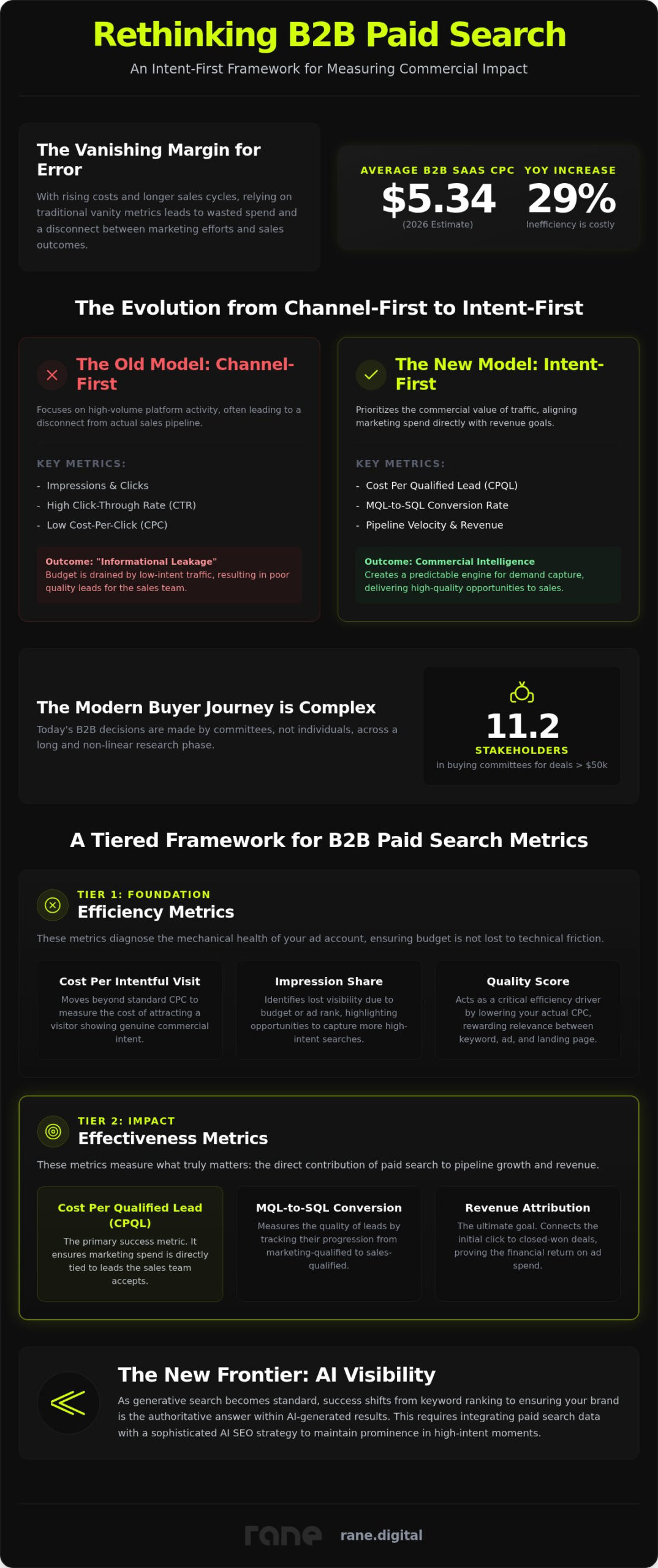
With non-branded B2B SaaS CPCs climbing to an average of $5.34 Today, a 29% year-over-year increase, the margin for inefficient ad spend has effectively disappeared. It’s frustrating to watch your budget vanish into high-volume clicks that fail to convert into meaningful pipeline. You likely recognize the disconnect between a dashboard full of green arrows and a sales team reporting low-quality leads. This misalignment often stems from a reliance on vanity signals rather than a robust framework of b2b paid search metrics that prioritize commercial intelligence.
We understand that a 6 to 12 month sales cycle requires more than just a low cost-per-lead; it demands strategic alignment between initial intent and long-term revenue. This article provides a clear reporting framework to bridge that gap. You’ll learn how to optimize for AI visibility, improve MQL-to-SQL conversion rates, and turn your paid search account into a predictable engine for demand capture.
Key Takeaways
- Shift your measurement focus from channel-specific activity to an intent-first model that accounts for complex, multi-stakeholder buyer journeys.
- Utilize a tiered framework of b2b paid search metrics to distinguish between mechanical platform efficiency and actual commercial effectiveness.
- Prioritize Cost Per Qualified Lead (CPQL) over traditional lead volume to ensure marketing spend directly correlates with sales pipeline growth.
- Leverage search data as commercial intelligence to maintain high-intent visibility within emerging AI-driven search environments.
- Establish a unified reporting structure that bridges the gap between digital signals and CRM outcomes for more accurate revenue attribution.
The Evolution of B2B Paid Search Measurement
The traditional linear marketing funnel has been replaced by a complex, non-linear web of interactions. B2B buyer journeys now involve multiple stakeholders and extended research phases, making it impossible to judge performance through a single session. According to data from April 2026, buying committees now average 11.2 stakeholders for deals exceeding $50,000. This shift requires a fundamental evolution in how we define success. Relying on isolated b2b paid search metrics often provides a false sense of security; a campaign may look healthy on paper while failing to contribute to the bottom line.
We are seeing a definitive move from ‘Channel-First’ reporting to ‘Intent-First’ models. In a channel-first model, marketers celebrate a low cost-per-click without questioning the commercial value of that traffic. An intent-first model prioritizes the quality of the signal over the quantity of the volume. It recognizes that capturing one high-intent decision-maker is more valuable than a thousand informational browsers. Standard search advertising metrics like impressions and clicks are merely the search foundation; they are not the end goal. Commercial performance indicators must instead focus on how these digital signals translate into pipeline velocity and revenue.
Why Traditional CTR is Often a Misleading Signal
High click-through rates do not always correlate with high-intent buyers in complex industries. In fact, a high CTR on broad, top-of-funnel keywords often signals that your budget is being drained by informational seekers who have no intention of purchasing. This “informational leakage” is a common friction point in B2B accounts. To combat this, we prioritize Intent-Matched CTR. Intent-Matched CTR is the only metric that matters for demand capture, as it specifically measures the engagement rate of users whose search queries align with bottom-of-funnel commercial intent.
The Role of AI in Modern Search Performance
Generative search engines and AI-powered bidding are fundamentally changing the concept of visibility. As of July 2026, Google’s updated terms of service allow the platform to generate ad targets and destinations by default using AI. This automation makes manual keyword tracking less relevant than measuring “AI Visibility”—your brand’s prominence within AI-generated answers and recommendations. Capturing this high-intent traffic requires a sophisticated AI SEO strategy that works in tandem with your paid efforts. By integrating b2b paid search metrics with AI-driven demand mapping, you ensure that your brand remains the authoritative choice across both paid and organic generative results.
Efficiency Metrics: Optimising the Search Foundation
Efficiency metrics measure the mechanical health of your ad account, ensuring that the technical execution of your strategy aligns with platform requirements. While these figures don’t directly track revenue, they serve as a vital diagnostic layer. They allow you to identify where friction in the account structure is causing budget leakage. By monitoring b2b paid search metrics at this foundational level, you can lower the entry cost of your leads before they even reach the sales pipeline. Today, with non-branded B2B SaaS CPCs averaging $5.34, the margin for technical inefficiency has effectively vanished.
We focus on the distinction between a standard Cost Per Click (CPC) and the Cost Per Intentful Visit. A low CPC is a deceptive victory if the traffic consists of informational seekers with zero commercial intent. True efficiency is found by optimizing for visits that demonstrate high-intent signals. This requires a granular analysis of Impression Share and Lost IS (Rank), which indicate when your ads are being suppressed due to poor bid strategy or low relevance scores. If you’re looking to refine your approach, mapping your demand is the first step toward reclaiming this lost visibility.
Does a Higher Quality Score Always Lead to Better B2B Leads?
A higher Quality Score does not inherently guarantee better lead quality, as it primarily measures the technical relevance of your ad and landing page to a specific keyword rather than the commercial intent of the user. However, it remains a critical efficiency driver because it directly influences your ad rank and actual CPC. Maintaining a high score requires a strategic partnerure where the ad copy, keyword, and site structure are perfectly synchronized. Often, fixing site foundations is the most effective way to improve these scores across the board, reducing the “tax” you pay to Google for every high-intent click.
Why is Impression Share Critical for Competitive Intelligence?
Impression share provides a transparent view of your market presence by quantifying the percentage of eligible searches where your brand actually appeared. It allows you to identify specific high-intent terms where competitors are outbidding you or where your budget is insufficient to capture the full demand. We distinguish between Search Impression Share, which tracks broad visibility, and Exact Match Impression Share, which focuses on the most precise, high-value queries. Lost IS (Budget) serves as a roadmap for budget scaling by highlighting exactly how much additional high-intent volume you could capture if your daily spend thresholds were increased to meet existing market demand.
Effectiveness Metrics: Measuring Pipeline and Revenue
Effectiveness metrics track the transition from a digital signal to a business outcome, moving beyond platform-specific data to measure real-world commercial impact. While efficiency metrics tell you how well the machine is running, effectiveness metrics tell you if it’s producing the right results. Many organizations fail by optimizing for a low Cost Per Lead (CPL) without scrutinizing lead quality. In the B2B sector, the only metric that truly validates your b2b paid search metrics framework is the Cost Per Qualified Lead (CPQL). This requires a deep integration between your ad platform and CRM to ensure that your conversions aren’t just form fills, but genuine opportunities.
We also monitor Conversion Rate (CVR) across different funnel stages to identify friction. A high Top-of-Funnel (TOFU) conversion rate coupled with a low Bottom-of-Funnel (BOFU) conversion rate suggests your landing pages are effective at capturing interest but your offer doesn’t align with deep-funnel intent. Conversely, a low TOFU conversion rate might indicate your messaging is too technical for an initial touchpoint. Balancing these rates ensures a steady flow of high-intent traffic through every stage of the journey, ultimately reducing the time a prospect spends in the consideration phase.
MQL to SQL Conversion Rates
A healthy MQL-to-SQL benchmark for B2B paid search typically ranges between 25% and 35%, though this varies based on the complexity of your offering and the strictness of your sales team’s acceptance criteria. If your rate falls below this, it’s often a symptom of poor keyword mapping. Capturing volume is easy; capturing intent is difficult. When ads target broad, informational queries, you generate Marketing Qualified Leads (MQLs) that lack the commercial urgency required to become Sales Qualified Leads (SQLs). Tracking the quality gap between marketing signals and sales acceptance is the only way to refine your targeting strategy for long-term growth.
Pipeline Velocity and Customer Acquisition Cost (CAC)
Calculating the true Customer Acquisition Cost (CAC) requires looking past the raw ad spend. You must include management fees, creative overhead, and the resources required for lead nurturing to get an accurate picture of profitability. Paid search serves as a catalyst for pipeline velocity by placing your solution in front of high-value accounts at the exact moment they’re seeking a resolution. This immediate demand capture effectively shortens the sales cycle, which is critical in industries where buyers consume an average of 13.4 pieces of content before contacting sales. To see how we synchronize these elements, you can explore our strategic process for aligning paid search with pipeline growth.
The New Frontier: AI Visibility and Commercial Intelligence
Traditional b2b paid search metrics are undergoing a significant expansion to include signals from generative engines like Search Generative Experience and Perplexity. Success in this landscape is no longer just about the isolated click; it’s about using search data to inform broader business strategy. This data-driven insight, which we define as Commercial Intelligence, allows organizations to move beyond reactive bidding and toward proactive market positioning. It provides a real-time window into how your audience’s language is evolving in the age of AI, allowing you to capture demand before it’s even fully articulated by the buyer.
We view every search query as a data point that contributes to your overall market understanding. By analyzing the intersection of paid performance and generative responses, you can identify which technical problems your prospects are trying to solve. This approach ensures that your ad spend does more than just generate leads; it builds a foundation of intelligence that influences product development, content strategy, and sales messaging. It’s a shift from merely buying traffic to owning a deep understanding of your customer’s intent journey.
Mapping Demand in the AI Era
Paid search provides the fastest feedback loop for identifying emerging search patterns in AI engines. While organic strategies can take months to reflect shifts in user behavior, your ad data reveals immediate changes in how prospects query AI-driven interfaces. We use this data to bridge the gap between paid and organic visibility, ensuring your brand remains present regardless of how the user chooses to search. Commercial Intelligence is the strategic byproduct of search performance, turning raw click data into a roadmap for your entire digital presence. By mapping this demand, you can identify high-intent clusters and emerging pain points before your competitors even recognize the trend.
Generative Engine Visibility Signals
The concept of “rank” is being replaced by “inclusion” in AI answers. In generative search, being the top result is less critical than being synthesized into the AI’s final recommendation. Measuring your ‘Share of Intent’ requires tracking how often your brand is cited as an authority within these responses. You can use your AI-led PPC management initiatives to test which specific messaging frameworks gain the most traction in these environments. This testing informs your broader authority-building efforts, which in turn improves your paid search conversion rates by establishing credibility before the user even reaches your landing page.
To secure your position in this evolving landscape, we recommend that you audit your commercial intelligence to align your current search foundations with long-term AI visibility.
Implementing a Performance-Driven Reporting Framework
A performance-driven reporting framework requires a unified dashboard that links Google Ads data directly to CRM outcomes, ensuring every digital interaction is measured against its contribution to the final sale. Establishing this link is the only way to validate your b2b paid search metrics against actual pipeline revenue. Without this visibility, you’re merely guessing which keywords are driving growth and which are simply inflating your cost-per-lead. In a landscape where buying committees average 11.2 stakeholders, a single-touch attribution model is insufficient. You need a data-driven approach that recognizes the cumulative value of multiple touchpoints across a 6 to 12 month cycle.
We prioritize the use of Commercial Intelligence to set realistic KPIs based on both your historical performance and current market demand. This involves moving away from static monthly reports and toward a dynamic system of continuous optimization. By integrating your search data with broader business intelligence, we turn raw numbers into a scalable growth engine. This ensures that your budget is always allocated to the highest-intent opportunities, maximizing your capture of the available market demand.
Aligning Search Foundations with Performance Goals
A B2B paid search strategy should be audited at least once every quarter, or immediately before any significant increase in monthly ad spend, to ensure the search foundation remains technically sound and commercially aligned. Scaling a campaign on a fractured site structure only accelerates budget leakage. A thorough technical audit identifies the friction points that prevent high-intent traffic from converting. By prioritizing site structure optimisation, you create a stable environment where your paid search metrics can accurately reflect your market authority and demand capture capabilities.
Turning Metrics into Consistent Revenue
Moving from monthly reporting to continuous commercial optimisation is the hallmark of a strategic partner approach to search performance. It’s about more than just keeping the lights on; it’s about refining every ad group and landing page to serve the overarching goal of revenue growth. This methodical progression ensures that your search foundations are always evolving alongside buyer behavior and emerging AI technologies. When your data is clean and your attribution is accurate, your paid search account stops being a cost center and becomes a predictable source of high-value pipeline.
If you’re ready to move beyond vanity signals and build a reporting framework that reflects your true commercial impact, you can book a strategic consultation to audit your b2b paid search metrics and align your account for long-term performance.
Aligning Search Performance with Commercial Outcomes
Mastering b2b paid search metrics is no longer a matter of monitoring platform activity; it’s about architecting a system that translates digital intent into pipeline revenue. By distinguishing between technical efficiency and commercial effectiveness, you can eliminate budget leakage and prioritize the high-intent signals that drive growth. This transition requires a move away from vanity metrics toward a framework rooted in commercial intelligence and AI visibility.
Success in the modern search landscape depends on a strategic partnerure that bridges the gap between search foundations and CRM outcomes. Our AI-focused performance mapping ensures that your brand remains the authoritative choice in generative search environments while maintaining a strict focus on lead quality. This structured approach allows you to capture demand with precision, turning your search account into a predictable engine for revenue generation.
You have the opportunity to transform your data into a powerful competitive advantage. Scale your high-intent revenue with a strategic audit and begin building a search strategy that prioritizes substance over superficial volume. We look forward to helping you achieve clarity and precision in your performance reporting.
Frequently Asked Questions
What are the most important B2B paid search metrics for the C-suite?
The C-suite prioritizes metrics that reflect commercial growth, specifically Pipeline Revenue, Customer Acquisition Cost (CAC), and Pipeline Velocity. Executives are less concerned with platform-level data like click-through rates and more focused on how ad spend accelerates the transition from an initial inquiry to a closed-won deal. Demonstrating a clear link between b2b paid search metrics and bottom-line revenue is essential for securing long-term budget buy-in.
How does B2B paid search measurement differ from B2C?
B2B measurement focuses on lead quality and multi-stakeholder influence rather than immediate transactional volume. While B2C often relies on impulse buys and high-frequency conversions, B2B campaigns must account for buying committees that now average 11.2 stakeholders for deals over $50,000. This complexity requires tracking engagement across a much longer sales cycle and prioritizing account-based signals over simple individual clicks.
Is ROAS a reliable metric for B2B companies with long sales cycles?
Return on Ad Spend (ROAS) is often an unreliable metric in B2B because it fails to capture offline revenue and the significant time lag between a click and a final purchase. In industries with 6 to 12 month cycles, a standard ROAS calculation provides an incomplete picture of performance. Instead, organizations should use Pipeline ROAS or Cost Per Qualified Lead (CPQL) to measure the strategic value of their search foundations.
What is a good cost per lead for B2B paid search?
A “good” cost per lead depends on your specific industry and average contract value, but verified benchmarks provide a useful baseline. The average B2B Google Ads Search CPA is $116.13, while the B2B Technology sector sees a slightly higher average of $133.52. If your costs significantly exceed these figures without a corresponding increase in lead quality, it may indicate a need for more precise demand mapping and keyword refinement.
How do I measure the impact of AI on my paid search performance?
Measuring AI impact involves tracking your “Share of Intent” and brand inclusion within generative engine responses. Traditional rank is becoming less relevant than your brand’s presence in AI-generated answers. You should monitor how often your solution is cited as a recommended authority and use b2b paid search metrics to test which messaging frameworks are most frequently synthesized by generative search algorithms.
Why is my B2B conversion rate lower than industry averages?
Low conversion rates often stem from a mismatch between search intent and the landing page offer or underlying friction in the site structure. The average B2B website conversion rate is approximately 2.9%, though B2B SaaS Search campaigns often see rates between 3% and 5%. If you’re falling below these benchmarks, it’s likely that your ads are capturing informational seekers rather than high-intent buyers ready for a commercial conversation.
How can I track offline conversions back to paid search clicks?
Tracking offline conversions requires a technical bridge between your ad platform and your CRM, typically using a Google Click ID (GCLID) or Enhanced Conversions. By importing sales data back into your ad account, you can see exactly which keywords and campaigns led to actual revenue. This closed-loop reporting is the only way to move beyond vanity metrics and achieve true commercial intelligence in your search performance.
What is the role of Quality Score in B2B lead generation?
Quality Score acts as a critical efficiency driver by determining your ad rank and actual cost-per-click. While it doesn’t directly measure lead quality, it serves as a diagnostic tool for how well your landing pages and ad copy align with user intent. Maintaining high scores allows you to capture more high-intent demand at a lower cost, ensuring your budget is used for market expansion rather than paying a technical penalty for poor site foundations.
Disclaimer
The information provided on this blog is for general informational and educational purposes only. While we strive to provide accurate and up-to-date content, the opinions and insights expressed here represent our best marketing judgments and should not be taken as professional, legal, or financial advice. Any reference to third-party websites or external links is provided for convenience and does not imply endorsement; we are not responsible for their content or accuracy. Digital marketing results vary based on individual effort, budget, and market conditions; we make no guarantees or warranties regarding specific outcomes or performance metrics resulting from the use of this information.
Want help with this? See our Google Ads management or book a discovery call.