

Most SEO forecasts fall apart the moment someone in finance asks what the traffic is actually worth. A chart of projected sessions does not win budget. A number for leads, customers and revenue does.
Start with the free calculator below. Pick your industry and it turns search volume and target rankings into visits, leads, customers and gross profit, then tells you whether that covers your SEO budget. Under it you will find benchmarks for 18 industries, then a walkthrough of how to forecast SEO traffic and revenue properly: the data you need, how to build the model, and how to allow for AI Overviews and zero-click searches.
Free tool
SEO forecast calculator
Pick your industry and the calculator loads typical numbers for it: average sale, repeat purchases, margin and conversion rates. Then set the searches you want to win. You will see what a lead is worth to you, how many customers you need to cover your SEO budget, and what your target rankings could earn. Change any number to your own. Nothing leaves your browser.
1Your business
2The searches you want to win
3Your numbers
What one customer is worth
What your target rankings could bring
Visits a month from these searches: - now, - at your target position.
-
-
How it works: monthly searches multiplied by the click-through rate for each position (- now, - at target), minus the AI Overviews setting, gives visits. Visits multiplied by your lead and close rates gives customers. Lifetime value is average sale multiplied by purchases per customer, and gross profit applies your margin. Gross profit per year is the lifetime gross profit of the customers you win in a year, before your SEO cost. Starting numbers are rounded US averages from public sources (see the table below). Other currencies are converted at about $1 = £0.76 = R16.50, and local prices differ, so use your own. Rankings usually take 6 to 12 months to move.
SEO forecast benchmarks by industry
The same rankings are worth very different amounts depending on what you sell. Say a plumber, a solar installer and an online store each move a group of keywords with 2,000 monthly searches from position 25 to position 5. Each gains about 83 extra visits a month. On the starting numbers below, that is worth roughly $9,000 a year in lifetime gross profit to the plumber, $75,000 to the solar installer and $1,000 to the online store.
Traffic does not decide whether SEO pays. What a customer is worth over time, your margin and how many visitors become paying customers decide it. That is why the calculator starts with your industry.
| Industry | Average sale | Purchases per customer | Gross margin | Visitor to lead | Lead to customer | Gross profit per lead | Customers a month to cover $1,500 of SEO |
|---|---|---|---|---|---|---|---|
| Plumber | $340 | 3 | 45% | 4% | 50% | $230 | 3.3 |
| Electrician | $375 | 2 | 42% | 4% | 50% | $158 | 4.8 |
| Roofing (replacement) | $9,600 | 1.1 | 37% | 3% | 30% | $1,172 | 0.4 |
| Solar installer | $31,000 | 1.1 | 35% | 2.5% | 25% | $2,984 | 0.1 |
| Battery / inverter backup | $13,400 | 1.1 | 30% | 2.5% | 20% | $884 | 0.3 |
| HVAC | $10,500 | 1.3 | 42% | 4% | 35% | $2,007 | 0.3 |
| Garage doors | $1,200 | 1.5 | 45% | 4% | 50% | $405 | 1.9 |
| Moving (local) | $1,700 | 1.2 | 30% | 4% | 39% | $239 | 2.5 |
| Pest control (recurring) | $200 | 16 | 50% | 4% | 50% | $800 | 0.9 |
| Cleaning (recurring) | $175 | 40 | 40% | 4% | 40% | $1,120 | 0.5 |
| Landscaping / lawn care | $255 | 20 | 45% | 4% | 35% | $803 | 0.7 |
| Renovation / remodel | $27,500 | 1.3 | 35% | 3% | 20% | $2,502 | 0.1 |
| Professional services | $2,500 | 4 | 45% | 4% | 20% | $900 | 0.3 |
| Training / online courses | $500 | 1.5 | 70% | 3.5% | 15% | $79 | 2.9 |
| Online store | $90 | 1.5 | 32% | 2.5% | 100% | $43 | 35 |
| Jewellery / diamonds | $2,000 | 1.2 | 40% | 1.2% | 100% | $960 | 1.6 |
| B2B supplier / wholesale | $1,000 | 8 | 31% | 3% | 10% | $248 | 0.6 |
| B2B SaaS (SMB) | $8,000 | 3 | 72% | 2% | 6% | $1,037 | 0.1 |
How to read the table: lifetime value is average sale multiplied by purchases per customer. Gross profit per lead is gross profit per customer multiplied by the close rate. The last column divides a $1,500 monthly SEO budget by gross profit per customer. Online stores sell directly, so their visitor to lead rate is the order rate and lead to customer is 100%. All figures are rounded US averages from 2025 and 2026 public data. Purchases per customer are mostly our estimates from typical repeat and retention patterns.
What the numbers tell you
- Low-value, one-off sales need volume. An online store with a $90 average order needs about 35 orders a month just to cover $1,500 of SEO. It needs high-volume keywords or a bigger order value before SEO pays.
- High-ticket trades need very few wins. Solar, HVAC, roofing and remodeling cover a typical SEO budget with less than one new customer a month.
- Recurring services are worth more than the ticket suggests. A $175 cleaning visit looks small, but at 40 visits per customer each customer is worth about $2,800 in gross profit.
- B2B buyers convert slowly but pay well. B2B SaaS turns few visitors into customers, yet one customer can be worth over $17,000 in gross profit, so a handful of high-intent keywords can carry the whole budget.
Sources
- Angi: plumber cost
- Angi: new roof cost
- Angi: moving trends
- EnergySage: solar panel cost
- EnergySage: home battery cost
- This Old House: electrician cost
- This Old House: renovation cost
- PickHVAC: HVAC replacement cost
- Bob Vila: garage door cost
- Bob Vila: pest control cost
- ThePricer: house cleaning cost
- LawnStarter: lawn care prices
- Ignition: accounting pricing benchmark
- Kajabi: course pricing
- Cartylabs: average order value by industry
- Ringly: ecommerce order value statistics
- Branvas: jewelry ecommerce benchmarks
- Blue Nile: average engagement ring cost
- GrowthSpree: B2B SaaS contract values
- Prospeo: B2B SaaS funnel benchmarks
- MetricNexus: conversion rates by industry
- Damodaran, NYU Stern: margins by sector
- Projul: profit margins by trade
- Service Fusion: contractor booking rates
- SurgePV: solar business profitability
- SmartMoving: moving company sales benchmarks
- Roofr: roofing sales metrics
- Hook Agency: contractor closing rates
- Hyperleap: legal client intake statistics
Key Takeaways
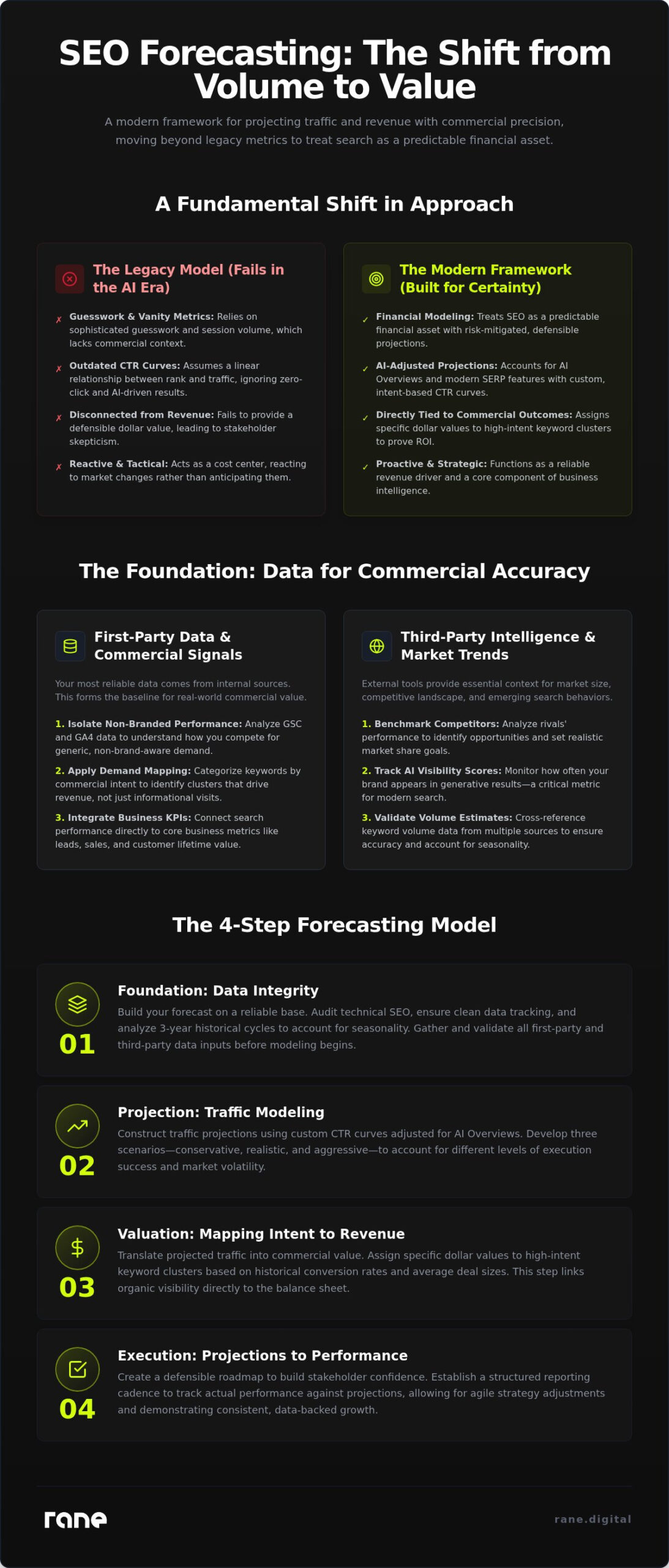
- Shift your perspective from volume-based estimates to risk-mitigated financial modeling that treats search as a predictable business asset.
- Master the framework for how to forecast seo traffic and revenue by integrating first-party data with precise demand mapping.
- Account for the impact of AI Overviews by applying custom CTR curves across conservative, realistic, and aggressive growth scenarios.
- Link organic performance directly to commercial outcomes by assigning specific dollar values to high-intent keyword clusters.
- Build stakeholder confidence with a defensible roadmap and a structured cadence for reporting actual performance against your strategic projections.
The Strategic Importance of SEO Forecasting in a Multi-Modal Landscape
SEO forecasting is a strategic exercise in risk mitigation and resource allocation. It isn’t just about guessing next month’s traffic; it’s about providing a defensible roadmap that justifies every dollar of marketing spend. For years, digital teams relied on traffic-only models that focused on volume over value. These models fail to satisfy commercial stakeholders because they lack a direct link to the balance sheet. In a landscape where Google’s AI Overviews appear in 15-30% of queries, simply ranking for high-volume terms no longer guarantees site visits. You need a model that accounts for how users actually interact with modern search results.
Understanding how to forecast seo traffic and revenue requires a shift from legacy link-counting to modern AI visibility metrics. This transition ensures that your growth plan isn’t just a hopeful projection but a calculated prediction of commercial capture. When you accurately forecast, you build long-term brand authority by demonstrating a consistent, data-backed ability to reach your target audience. It’s the difference between a reactive tactic and a proactive business strategy.
Why Traditional Projections Fail in the AI Era
Traditional projections are crumbling under the weight of zero-click searches and multi-modal results. Legacy click-through rate (CTR) models assume a linear relationship between rank and traffic, yet AI-generated responses often satisfy user intent directly on the search results page. This disruption makes historical data a poor predictor of future performance. To maintain accuracy, you must employ Demand Mapping. This process identifies exactly where commercial value resides by segmenting keywords based on user intent rather than just search volume. Without this layer of intelligence, your forecast will likely overestimate traffic while underestimating the difficulty of capturing actual revenue.
Aligning Search Performance with Business Intelligence
Smart organizations treat search as a primary revenue driver, not a technical expense. By mastering how to forecast seo traffic and revenue, you enable a proactive marketing strategy that anticipates market shifts rather than reacting to them. This foresight is critical for scaling operations and securing internal buy-in. Realizing this level of precision starts with robust SEO foundations. When your site structure and data tracking are aligned with commercial goals, your forecasts become reliable tools for business intelligence. This alignment ensures that every SEO activity contributes directly to a connected system of growth, turning abstract visibility into tangible commercial certainty.
The Foundation: Essential Data Points for Commercial Accuracy
Accuracy in how to forecast seo traffic and revenue starts with the integrity of your data inputs. You cannot build a reliable model on top of “dirty” data or inflated vanity metrics. Before building your projection, you must audit your SEO foundations to ensure your site structure is capable of supporting the growth you predict. A broken technical base will inevitably lead to a failed forecast; regardless of how sophisticated your math is. You must also account for seasonality and industry-specific market trends by analyzing three-year historical cycles to ensure your model survives seasonal fluctuations.
First-Party Data: Search Console and Commercial Signals
Extraction begins with Search Console and GA4. Your first step is to isolate non-branded historical performance to see how your site actually competes for generic demand. Branded traffic is a measure of brand equity; not SEO performance. Once you have a clean dataset, use Demand Mapping to categorize these keywords by commercial intent. This allows you to identify clusters that actually drive revenue rather than just informational sessions. Commercial Intelligence is the integration of search data with business KPIs. By mapping these signals, you create a baseline that reflects real-world commercial value.
Third-Party Intelligence: Market Demand and AI Trends
Third-party tools provide the necessary context for competitor benchmarking and market trends. In the current landscape, you must look beyond traditional volume to track AI Visibility scores. This metric reveals how often your brand appears in generative search results and AI-powered answer engines. It is a critical component for any modern forecast. When validating third-party keyword estimates, use this checklist to ensure accuracy:
- Cross-reference volume data across at least two independent sources.
- Adjust for seasonality based on multi-year historical trends in your specific vertical.
- Analyze the current SERP features to calculate a realistic “available” CTR.
- Align keyword difficulty with your current domain authority and backlink profile.
Refining these inputs ensures your roadmap is defensible. If you are struggling to bridge the gap between traffic numbers and business outcomes, exploring advanced demand capture strategies can provide the necessary clarity. This level of precision is what separates a strategic partner from a standard practitioner.
For agencies
Need SEO forecasts for client pitches?
RANE works as your back office. We help partner agencies with audits and proposals, then deliver the SEO in your client accounts under your brand. You keep the relationship and the margin.
Constructing the Model: A Step-by-Step Approach to Traffic Projections
A robust model for how to forecast seo traffic and revenue requires a weighted approach that accounts for market volatility. You shouldn’t rely on a single “best-case” number; instead, build three distinct scenarios: Conservative, Realistic, and Aggressive. This structured methodology provides stakeholders with a clear view of potential outcomes and the specific levers required to reach them. For a deeper look at navigating these shifts, refer to our AI SEO strategic guide. By layering these scenarios, you move from blind guessing to a defensible roadmap based on commercial intelligence.
Step 1: How do you establish baseline performance and seasonal normalisation?
Establishing a baseline involves creating a “status quo” projection that represents your site’s performance without any new optimization efforts. This provides the necessary control for your model. You must remove noise like bot traffic or one-off viral spikes that can skew your averages. Calculate your year-on-year growth rate by subtracting last year’s traffic from this year’s, then dividing by last year’s total. This provides a clean starting point for layering on incremental gains and ensures your forecast survives seasonal fluctuations.
Step 2: How do you apply intent-based CTR curves?
Applying intent-based CTR curves requires differentiating between informational and transactional queries to account for varying user behaviors. Standard models fail because they assume a linear relationship between rank and clicks. Informational queries often see lower click-through rates due to AI Overviews satisfying the query on the SERP, while transactional queries maintain higher engagement. Topical Authority is the primary lever for ranking in AI search and securing citations in generative overviews. When your content demonstrates deep expertise, you’re more likely to appear in the “AI citation” block, which can drastically alter traditional click-through expectations.
Step 3: How do you forecast AI visibility and generative citations?
Forecasting AI visibility involves using entity-based search signals to predict how often your brand will appear in generative search citations. This methodology relies heavily on Entity SEO, which focuses on the relationships between concepts and your brand. You must adjust your traffic estimates for zero-click environments where an AI Overview satisfies the user without a site visit. Calculating “Incremental Traffic” involves projecting the new visitors gained specifically from your optimization efforts, separate from your baseline growth. This ensures your roadmap remains grounded in actual performance gains rather than general market trends.
Mapping Intent to Revenue: Calculating Commercial Value and ROI
Revenue mapping is the process of assigning specific financial values to distinct intent clusters. It moves beyond the generic traffic estimates discussed in earlier steps to provide a clear picture of commercial potential. If you want to understand how to forecast seo traffic and revenue effectively, you must stop treating every session as a potential conversion. Instead, align your content with revenue buckets using our Keyword Mapping guide. This ensures your projections reflect commercial reality rather than just ranking potential.
By categorising your data into high, medium, and low-intent segments, you can predict which activities will move the needle on your balance sheet. This granular approach allows you to justify investments in long-term growth by showing exactly how visibility in one area feeds the conversion funnel in another. It’s about building a model that stakeholders can actually trust.
The Formula for SEO Revenue Projections
A site-wide conversion rate is a dangerous oversimplification that often leads to missed targets or inflated expectations. A user searching for a “how-to” guide converts at a vastly different rate than one looking for “pricing” or “buy now” terms. The accurate formula for a defensible forecast is: (Projected Traffic x Intent-Specific Conversion Rate) x Average Order Value (AOV). By segmenting your forecast this way, you provide stakeholders with a granular view of where the money actually comes from. This transparency is vital for securing budget approval for complex search initiatives.
| Intent Category | Typical Conversion Rate | Strategic Role |
|---|---|---|
| Informational | 0.1% – 0.5% | Authority & Awareness |
| Investigational | 1.0% – 2.5% | Consideration & Trust |
| Transactional | 3.0% – 10.0%+ | Direct Revenue Capture |
Calculating the ROI of AI Visibility
Measuring the return on SEO authority building requires looking at both direct conversions and the “unearned” brand trust generated by AI citations. When an AI search engine cites your brand as a primary source, it acts as a powerful third-party endorsement that significantly shortens the sales cycle. This visibility often captures high-intent demand at a fraction of the cost of Paid Search, where bidding for the same terms can be prohibitively expensive. You should also integrate Customer Lifetime Value (CLV) into your model to see the full picture. SEO is a compounding asset; the revenue generated from a single acquisition often repeats over years, which increases the true ROI of your initial investment. If you need to bridge the gap between search visibility and commercial results, you can request a custom demand capture audit to refine your projections and identify untapped revenue clusters.
Strategic Execution: Pivoting from Projections to Performance
Projections only hold value if they lead to decisive action. A forecast is a living document, not a static promise. Mastering how to forecast seo traffic and revenue is the first step; the second is maintaining the credibility of those numbers through rigorous execution. You must act as the strategic partner, translating complex search data into the language of business risk and commercial opportunity. This ensures that every technical fix and content asset is treated as a calculated investment rather than a shot in the dark. It moves the conversation from rankings to revenue.
How do you secure stakeholder buy-in with data clarity?
Stakeholder buy-in is secured by reframing SEO uncertainty as a manageable business risk through clear, revenue-focused executive summaries. Decision-makers don’t need to see keyword rankings; they need to see how search visibility protects market share and drives predictable growth. When objections arise regarding the unpredictability of search, point to the weighted scenarios developed in your model. This demonstrates that you’ve already accounted for volatility. Presenting your data with rhythmic, authoritative clarity positions you as a partner in growth rather than a vendor of technical tasks.
How should you monitor and adjust your forecast?
Monitoring your forecast requires a quarterly review process to update growth assumptions based on real-world performance data and market shifts. External factors, such as core algorithm updates or the expansion of AI search features, will inevitably cause fluctuations in your original projections. You must be prepared to pivot your strategy when these disruptions occur. Continuous SEO Monitoring is essential for protecting projected revenue, as it allows you to identify and address performance gaps before they impact the bottom line. This cadence of “Forecast vs. Actual” reporting builds long-term trust by showing total control over the process.
Use your forecasting data to prioritize high-impact content writing and technical fixes that offer the shortest path to revenue capture. If your data shows a specific intent cluster is underperforming, reallocate resources to shore up that foundation immediately. This proactive approach ensures your roadmap remains aligned with commercial goals. To build a bespoke commercial model for your organization, book a strategy session with our team to align your search foundations with long-term revenue growth.
Building a Defensible Path to Commercial Certainty
Transforming search into a predictable revenue asset requires a fundamental shift from tracking clicks to mapping commercial demand. You’ve seen that the modern search landscape demands more than just historical data; it requires a deep understanding of AI visibility and intent-specific conversion curves. By building a weighted model that accounts for market volatility, you can replace boardroom skepticism with a defensible growth roadmap. This process moves your digital strategy from a technical cost center to a core driver of business intelligence.
Mastering how to forecast seo traffic and revenue is about more than just hitting numbers. It’s about establishing the structural foundations that allow your brand to capture high-intent demand in a zero-click environment. When you align your SEO activities with commercial goals, you move from reactive tactics to proactive market leadership. This disciplined approach ensures your digital strategy remains resilient against algorithm shifts and emerging technologies.
Secure your commercial growth strategy by booking a consultation with RANE today. Our team specializes in the AI-driven Demand Mapping framework and the strategic partner approach to search performance. You can turn your organic search presence into a reliable, compounding financial asset that drives long-term commercial value. Your journey toward certain growth begins with a single, data-backed step.
Frequently Asked Questions
How accurate are SEO forecasts in an AI-driven search market?
Accuracy depends on incorporating AI visibility and zero-click trends rather than relying on linear CTR models. While no forecast is 100 percent precise, a weighted model with conservative and aggressive scenarios provides a reliable range for decision-making. You must treat these numbers as strategic guideposts that require quarterly calibration to account for the evolving generative search landscape. This iterative approach ensures your commercial roadmap remains grounded in current reality.
What tools are essential for forecasting SEO traffic and revenue?
Essential tools include Search Console for first-party data and business intelligence platforms for revenue tracking. You should also utilize AI-visibility trackers to monitor your presence in generative citations. While third-party keyword tools provide volume estimates, the most critical tool is a custom-built model that integrates your specific conversion rates and average order values. This integration is vital for turning raw data into actionable commercial intelligence.
How long does it take for SEO efforts to reflect in a revenue forecast?
SEO efforts typically take 6 to 12 months to show measurable traffic gains, with a full return on investment often realized between 12 and 18 months. This timeline is a standard industry benchmark that accounts for the compounding nature of authority building. Your forecast should reflect this ramp-up period to manage stakeholder expectations and prevent premature pivots. Early indicators like improved impressions and ranking shifts can validate the model before revenue peaks.
Should I use historical data or keyword-based models for my forecast?
A hybrid approach is best for understanding how to forecast seo traffic and revenue with commercial precision. Historical data provides a baseline for seasonal normalization, while keyword-based models allow you to project growth in new, untapped intent clusters. Relying solely on history ignores market expansion; keyword models alone often fail to account for existing site authority. Combining both methods allows you to build a roadmap that is both realistic and ambitious.
How do I account for Google algorithm updates in my SEO projections?
Accounting for algorithm updates involves building a risk buffer into your conservative growth scenario. You shouldn’t try to predict the exact timing of a core update, but you can model the impact of potential volatility based on historical industry shifts. Maintaining a diverse portfolio of content and strong technical foundations helps protect your projected revenue from sudden ranking fluctuations. This proactive risk management is a hallmark of the strategic partner approach.
Can I forecast revenue for a brand-new website with no historical data?
You can forecast for a brand-new website by using competitor benchmarking and industry-standard conversion rates as proxies for historical data. This approach requires a more conservative realistic scenario since you lack an established authority baseline. Focus on mapping the total addressable market to identify the ceiling for your initial growth phases while your domain gains credibility. This ensures your early-stage investments are aligned with the most profitable search clusters.
What is the difference between a traffic forecast and a demand map?
A traffic forecast predicts volume, whereas a demand map categorizes that volume by commercial intent and revenue potential. Traffic projections often include vanity metrics that don’t contribute to the bottom line. Demand mapping ensures you prioritize the high-intent clusters that drive actual sales. This makes it a more sophisticated tool for strategic resource allocation. It moves the focus from generic visibility to the specific capture of commercial value.
Disclaimer
The information provided on this blog is for general informational and educational purposes only. While we strive to provide accurate and up-to-date content, the opinions and insights expressed here represent our best marketing judgments and should not be taken as professional, legal, or financial advice. Any reference to third-party websites or external links is provided for convenience and does not imply endorsement; we are not responsible for their content or accuracy. Digital marketing results vary based on individual effort, budget, and market conditions; we make no guarantees or warranties regarding specific outcomes or performance metrics resulting from the use of this information.