

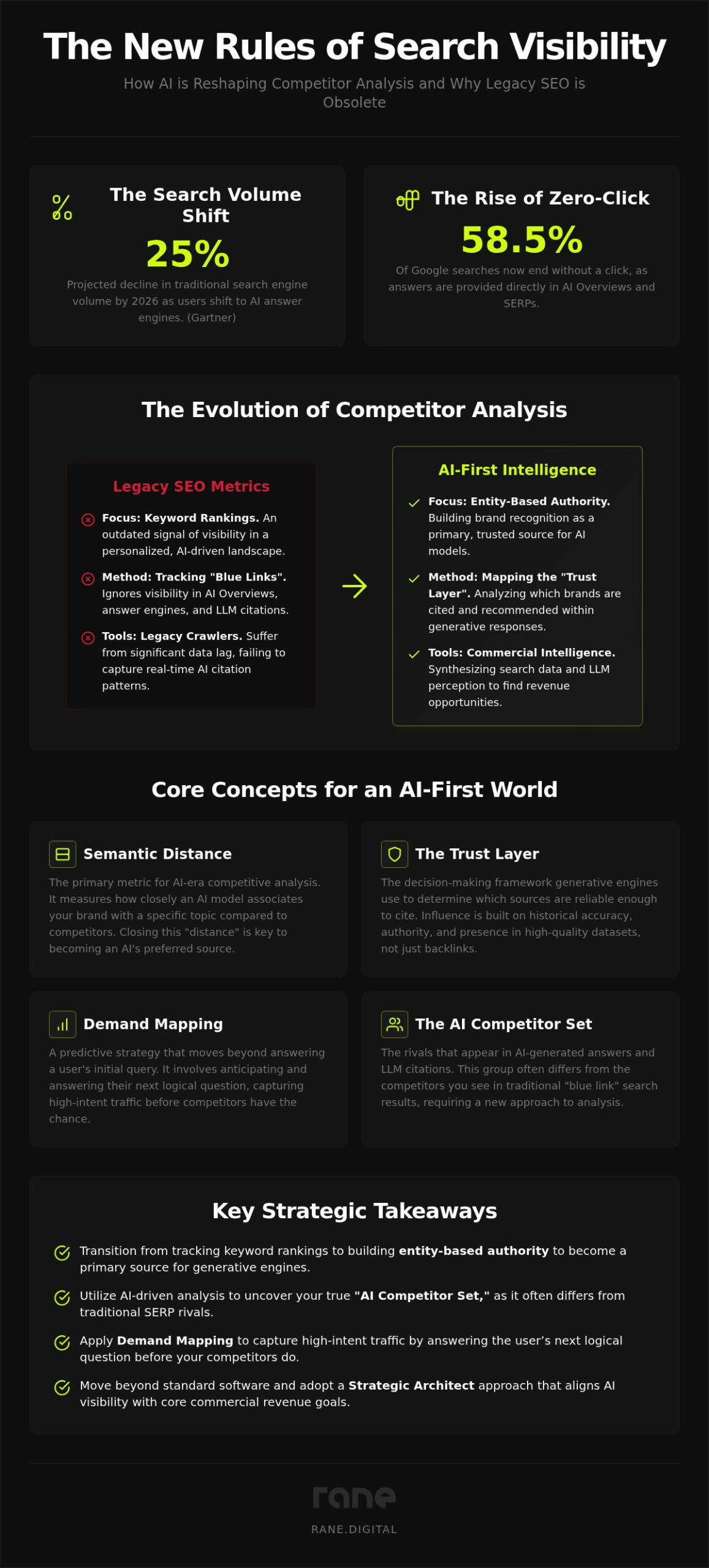
Gartner projects a 25% decline in traditional search engine volume now as users migrate toward AI-driven answer engines. This shift represents a fundamental change in how your audience finds information, yet most brands still rely on legacy tools that track blue links instead of commercial intelligence. You’ve likely noticed that traditional SEO data feels increasingly disconnected from reality, especially when competitors appear in AI Overviews and LLM citations while your own visibility remains stagnant. Relying on outdated metrics in an AI-first world makes it impossible to see why certain brands are winning the citation game. Mastering ai-driven competitor analysis for seo is no longer optional; it’s the only way to audit the semantic distance between your brand and your rivals within an LLM’s knowledge graph.
We understand the frustration of trying to map competitor intent at scale when the rules of the game change with every model update. This article provides a clear framework for mapping your AI visibility and offers actionable intelligence to leapfrog competitors in generative engines. You’ll learn how to transition from basic rank tracking to a sophisticated system of demand mapping that aligns your search strategy with actual revenue goals. We will explore how to secure your brand’s authority and ensure you remain the primary answer in a landscape where 58.5% of Google searches now end without a single click.
Key Takeaways
- Transition from tracking keyword rankings to building entity-based authority to ensure your brand remains a primary source for generative engines.
- Utilize ai-driven competitor analysis for seo to uncover your “AI Competitor Set,” as these rivals often differ from those appearing in traditional blue links.
- Synthesize competitor messaging through custom models to identify the specific semantic gaps and unserved intents they’ve left unaddressed.
- Apply Demand Mapping to capture high-intent traffic by answering the user’s next logical question before your competitors do.
- Move beyond standard software solutions by adopting a strategic partner approach that aligns AI visibility with your core commercial revenue goals.
The Evolution of Competitor Analysis in the AI Search Era
Traditional competitor analysis has long relied on a predictable set of metrics: keyword rankings, domain authority, and backlink volume. These signals were sufficient when search engines operated as simple indexers of information. However, the shift from Search Engine Result Pages (SERPs) to Generative Engine Responses has fundamentally altered the competitive landscape. Today, success requires a pivot toward commercial intelligence that prioritises semantic relevance and entity-based authority over simple rank tracking. This transition marks the end of the “blue link” era and the beginning of a landscape defined by citation frequency and model trust.
Adopting ai-driven competitor analysis for seo allows you to move beyond the surface. It enables you to examine how Large Language Models (LLMs) perceive your brand’s relationship to specific topics. It isn’t just about who ranks first; it’s about which brand the AI considers the most authoritative source to cite in a generated answer. This evolution forces marketers to look at the “semantic distance” between their content and their competitors’ within an LLM’s knowledge graph. Understanding this distance is the key to closing the gap and becoming the preferred reference for AI engines.
Why Traditional SEO Tools Are No Longer Sufficient
Traditional crawlers often suffer from significant lag times that make them ill-equipped for the current pace of change. While an AI model might be trained on data from hours ago, legacy SEO tools may take weeks to reflect changes in citation patterns. Personalisation also complicates matters. AI overviews are increasingly tailored to individual user intent, making static “position tracking” an unreliable metric for actual visibility. Most legacy tools simply fail to capture the nuances of how LLMs select their sources, leaving brands blind to why a competitor is suddenly being cited as the definitive expert. This lack of transparency creates an execution gap that traditional software cannot bridge.
Defining AI-Driven Commercial Intelligence
AI-driven commercial intelligence is the strategic synthesis of search data and LLM perception to identify high-value revenue opportunities. This approach relies heavily on intent mapping to understand not just what users are searching for, but the underlying problem they’re trying to solve. By leveraging commercial intelligence, brands can move from reactive monitoring to a predictive strategy. This allows for a more intentional approach to content creation that aligns with the user’s next logical question. It effectively leapfrogs competitors who are still stuck in a keyword-first mindset, ensuring your brand captures demand at the exact moment of intent.
Mapping AI Visibility: How Generative Engines Rank Your Competitors
LLMs operate on a “black box” logic that prioritises information retrieval based on semantic proximity rather than just a backlink count. This represents a fundamental departure from traditional search logic. Conducting an ai-driven competitor analysis for seo requires shifting your focus from domain authority to the “Trust Layer” of the web. This layer is where generative engines decide which sources are reliable enough to cite in a natural language response. While traditional metrics measure the potential for a page to rank, AI Visibility measures the actual influence a brand exerts within generative responses. It’s a shift from being indexed to being recommended.
Semantic distance is the primary metric for competitive positioning today. This concept describes how closely an AI model associates your brand with a specific topic or user intent. If a competitor is cited more frequently, it’s because the model’s knowledge graph perceives them as the most relevant entity for that cluster. You can’t bridge this gap with keyword stuffing; it requires building a network of contextually relevant signals that prove your authority to the model. Understanding why certain competitors get cited more often involves auditing their “Trust Layer,” which includes their presence in high-authority datasets and their historical accuracy in answering complex queries.
Analysing the Knowledge Graph Influence
AI engines associate entities like brands, people, and specific concepts with broader topics to build their understanding of the world. To identify which entities the AI associates with your competitors, you must look at the surrounding context of their citations across multiple platforms. Digital PR plays a massive role here because it shapes the AI’s “opinion” by placing the brand in authoritative, high-context environments. You can use LLMs to reverse-engineer competitor content strategies by asking the model to explain why it chose specific sources over others. This process reveals the specific authority markers the AI is looking for and helps you refine your own positioning.
The Citation Audit: Who Does the AI Trust?
A robust framework for tracking competitor mentions across platforms like Perplexity, Gemini, and Google’s AI Overviews is essential for modern growth. This citation audit reveals the “Authority Gap” between your brand and the market leader. Since only 14% of marketers are currently tracking their brand’s visibility within AI-generated answers, gaining this insight provides a significant competitive edge through ai-driven competitor analysis for seo. By understanding where your rivals are mentioned, you can identify which nodes in the knowledge graph you need to target next. For a deeper look at these dynamics, see our guide on AI SEO today. If you’re struggling to see where you stand, our AI Visibility mapping services can bridge that intelligence gap.
Executing AI-Driven Competitor Audits
Executing a rigorous ai-driven competitor analysis for seo requires a departure from traditional spreadsheet-based monitoring. It’s a multi-stage process that moves from identifying who is actually stealing your visibility to understanding the specific semantic depth they provide. Most brands fail because they audit the wrong rivals. They focus on commercial competitors while informational giants dominate the generative response space. To win, you must treat every cited entity as a direct threat to your brand’s authority.
The first stage involves defining your AI Competitor Set. These are the sources an LLM consistently pulls from to answer queries in your niche. Once identified, you can use custom GPTs to extract and synthesise their messaging. This allows you to see the exact structure of their arguments and the specific claims they make to earn model trust. It’s about finding the “why” behind the citation. You’re looking for the logical framework they’ve built to satisfy the model’s requirements for accuracy and depth.
Next, you must map their demand capture against actual search intent. Are they providing a solution, or are they just repeating industry platitudes? Benchmarking your semantic coverage against industry leaders reveals where your content lacks the necessary depth to be considered a primary source. AI engines prioritise “information gain,” which is the inclusion of unique, verifiable facts that aren’t present in other sources. If your content doesn’t add something new to the conversation, it’s invisible to the engine.
Identifying Your True AI Competitors
Informational giants like Wikipedia or Reddit are often your most significant rivals in generative search. While they don’t sell your product, they capture the top-of-funnel visibility that should lead to your site. You must differentiate between commercial competitors and visibility competitors to understand your true “Share of Model” (SoM). Share of Voice is no longer enough. You need to know how much of the LLM’s knowledge graph your brand occupies compared to these high-authority entities.
Benchmarking Semantic Depth
AI engines are increasingly adept at identifying “thin” content that lacks unique value. To stay ahead, you need to compare the information gain of your articles against the market leaders. This involves looking for specific data points, unique perspectives, or expert insights that competitors have missed. Building topical authority SEO ensures that your content provides the semantic depth required to be cited as a primary expert. If your content merely summarises existing information, it’s likely to be ignored by generative engines in favour of more comprehensive sources.
Identifying and Exploiting Competitor Content Gaps
Identifying unserved intent is the next frontier of competitive strategy. Traditional tools show you what rivals have written, but they often fail to reveal what the user actually needs next. By leveraging ai-driven competitor analysis for seo, you can pinpoint the specific questions and problems that your competitors are currently ignoring. This process isn’t just about finding missing keywords; it’s about identifying commercial opportunities where the market is underserved. When competitors provide generic or shallow answers, your brand can step in with high-value solutions that capture high-intent commercial traffic.
The “Information Gain” strategy is the most effective way to exploit these identified gaps. Generative engines prioritise content that adds unique, verifiable information to their knowledge graph. If your content merely rehashes existing perspectives, it offers zero information gain and will likely be excluded from AI citations. You must provide original data, unique case studies, or proprietary insights that aren’t present in the current competitive set. This creates a semantic advantage that makes your brand the most authoritative reference for both the user and the model.
Demand Mapping for Competitive Advantage
RANE Digital utilizes a methodical approach to Demand Mapping to identify exactly where a competitor’s content strategy fails to satisfy the user journey. We use these insights to fix site structures and build content pillars that proactively address the user’s next logical question. This approach transforms competitor weaknesses into your own strategic assets. By aligning your content with the actual flow of user intent, you ensure that your site functions as a cohesive system for capturing demand rather than a disconnected set of pages. You can refine your own strategy by following our Keyword Mapping Guide.
Architecting for AI Visibility
Securing visibility in generative search requires a technical environment that supports easy ingestion and citation. You must structure your data so AI engines can clearly define the relationship between your brand and specific topics. This involves building a robust Search Foundation through technical SEO, including the use of structured data and clear content hierarchies. When your technical architecture is aligned with your content strategy, you reduce the friction for LLMs to recognise and recommend your brand. To begin mapping your market demand and improving your authority, explore our AI SEO Services for a tailored strategic audit. This intentional approach ensures that your ai-driven competitor analysis for seo results in tangible commercial growth.
Scaling Your AI Visibility with RANE Digital
RANE Digital bridges the gap between raw data and commercial performance. While ai-driven competitor analysis for seo provides the necessary foundation for growth, the execution requires a specialised skillset that moves beyond standard agency models. We integrate commercial intelligence into every layer of performance marketing, ensuring that your brand isn’t just present in search results but is the preferred choice for generative engines. This involves a deep commitment to authority building and demand capture, turning abstract visibility into a tangible competitive advantage that rivals cannot easily replicate.
Our strategic partner approach differentiates us from agencies that rely solely on automated reports. We view your digital presence as a connected system where every piece of content and every technical optimisation serves a specific revenue goal. By mapping the competitive landscape with precision, we identify the high-intent traffic that your rivals are leaving on the table. Our internal data and case studies consistently demonstrate that capturing this demand requires more than just better content; it requires a superior understanding of how AI models distribute trust across the knowledge graph.
Turning Intelligence into Revenue
Data without strategy is just noise. At RANE Digital, we focus on the metrics that actually impact your bottom line: conversion, revenue, and market share. We turn searches into consistent revenue by aligning your brand’s expertise with the specific problems your audience is trying to solve in real-time. This methodical approach ensures that every strategic pivot is backed by logical proof and clear commercial value. You can see how we implement these frameworks and scale authority by exploring our Process in detail.
Next Steps for Your AI Strategy
The shift toward generative search is accelerating, and the brands that act now will define the next decade of digital visibility. A dedicated AI search strategy is no longer a luxury for forward-thinking enterprises; it’s a fundamental requirement for survival. Waiting for the market to stabilise is a recipe for irrelevance while your competitors secure their place in the citation layer. Take control of your brand’s future and ensure you are the answer users find when they need a solution. Book a strategic consultation to audit your AI visibility and begin your transformation today.
Securing Your Future in the Generative Search Landscape
The transition from traditional rank tracking to generative search visibility requires a fundamental shift in how you perceive market competition. Success in this era depends on your ability to audit the semantic distance between your brand and your rivals within the LLM knowledge graph. By adopting ai-driven competitor analysis for seo, you move beyond reactive monitoring and begin to proactively shape how AI engines recommend your brand to high-intent users. This shift ensures your brand remains visible where users are actually finding answers.
RANE Digital provides the specialised AI SEO and Demand Mapping expertise needed to bridge the gap between complex search data and actual revenue growth. Our strategic partner approach ensures your search foundations are built for long-term authority rather than temporary gains. It’s time to stop guessing why competitors are cited and start building the commercial intelligence required to dominate your niche. Secure your brand’s AI Visibility with a strategic audit and take the first step toward reclaiming your market share. The generative search era is here; make sure your brand is the primary answer.
Frequently Asked Questions
What is AI-driven competitor analysis for SEO?
AI-driven competitor analysis for SEO evaluates how rivals are positioned within an AI model’s knowledge graph rather than just tracking their keyword rankings. This process uses machine learning to identify the semantic relevance and entity-based authority that leads to brand citations in generative search. It allows you to understand the logical framework competitors use to earn trust from large language models.
How does AI-driven analysis differ from traditional SEO monitoring?
Traditional monitoring focuses on static metrics like backlink volume and domain authority, while ai-driven competitor analysis for seo prioritises semantic distance and information gain. Traditional tools often miss the nuances of personalised AI Overviews and suffer from significant data lag. AI-driven audits examine the “Trust Layer” to reveal why a generative engine recommends one brand over another in real-time.
Which tools are best for AI-powered competitor research today?
Semrush’s Starter plan now includes dedicated AI visibility tracking for $199 per month, while SpyFu’s Pro + AI plan offers competitive intelligence for $119 per month. Visualping is an effective choice for monitoring visual site changes, with business plans starting at $100 per month. These tools should be paired with custom GPTs to reverse-engineer the content strategies that rivals use to secure citations.
Can AI help identify competitor content gaps?
AI identifies “unserved intent” by comparing competitor content against the full spectrum of user queries within a specific niche. It highlights where rivals provide generic answers or fail to address the user’s next logical question. Mapping these gaps allows you to create content with high information gain, which generative engines prioritise when selecting primary sources for their responses.
How do I track my competitors in AI search results like Gemini or SGE?
Tracking requires a citation audit that monitors brand mentions and source links across platforms like Perplexity, Gemini, and Google’s AI Overviews. You must evaluate the frequency and context of competitor citations to identify their perceived authority. This data reveals the specific nodes in the knowledge graph where your rivals are strongest, allowing you to target those areas in your own strategy.
What is “Share of Model” and why does it matter for SEO?
Share of Model (SoM) measures the percentage of an LLM’s knowledge graph that your brand occupies compared to your competitors. It’s a critical metric because generative engines recommend trusted entities rather than just displaying a list of links. A high SoM indicates that the AI perceives your brand as a definitive expert, which leads to more frequent and prominent citations in generated answers.
How often should I perform an AI-driven competitive audit?
Quarterly audits are sufficient for most brands, though highly competitive sectors should consider monthly reviews to keep pace with model updates. Because generative engines evolve rapidly, your ai-driven competitor analysis for seo must account for frequent shifts in citation logic. Regular auditing ensures your strategy remains predictive, allowing you to capture high-intent demand before your competitors can pivot.
Is AI competitor analysis suitable for small businesses or just enterprises?
Small businesses can use AI-driven audits to identify niche opportunities that larger enterprises often overlook due to their scale. While enterprises have more resources, smaller brands can build deep topical authority in specific areas to secure AI citations. This allows agile businesses to compete effectively by providing the unique insights and semantic depth that generative engines value most.
Disclaimer
The information provided on this blog is for general informational and educational purposes only. While we strive to provide accurate and up-to-date content, the opinions and insights expressed here represent our best marketing judgments and should not be taken as professional, legal, or financial advice. Any reference to third-party websites or external links is provided for convenience and does not imply endorsement; we are not responsible for their content or accuracy. Digital marketing results vary based on individual effort, budget, and market conditions; we make no guarantees or warranties regarding specific outcomes or performance metrics resulting from the use of this information.