

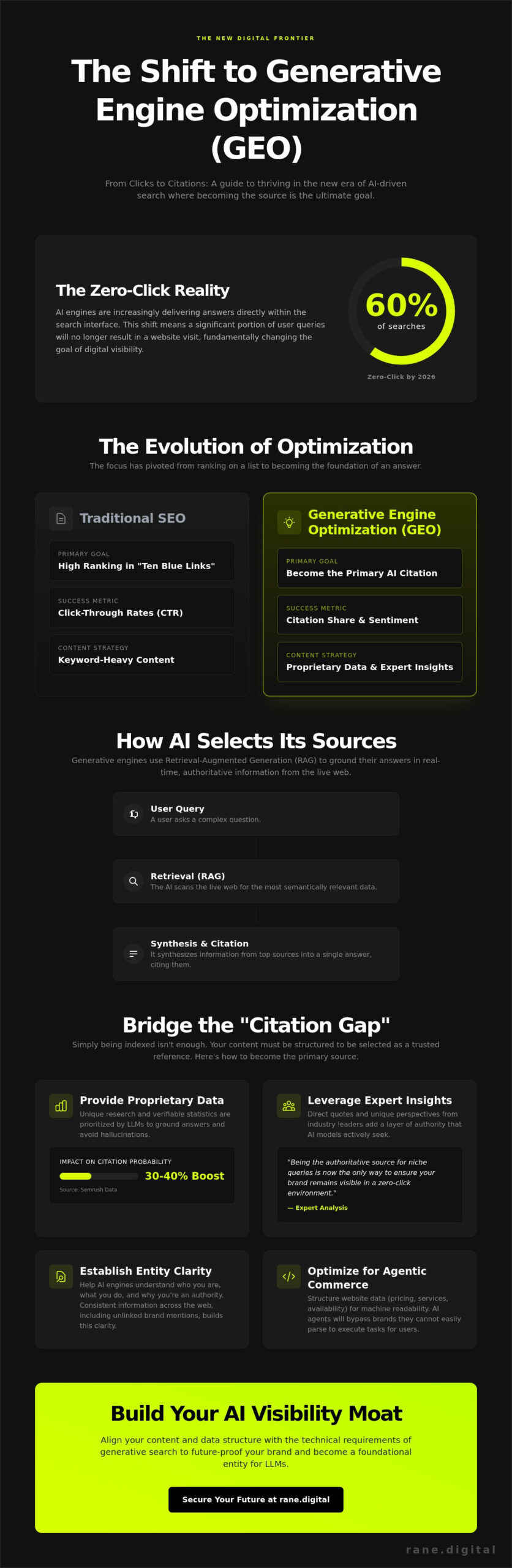
By the end of 2026, research suggests that 60% of all searches will result in no website clicks as AI engines deliver answers directly to the user. This shift marks the end of the traditional search era and the rise of generative engine optimization, a strategy focused on becoming the definitive source for AI-synthesized answers. You’ve likely watched your organic click-through rates soften even while your rankings stay firm. It’s a frustrating reality where AI overviews capture the intent you worked hard to build, leaving many brands confused about how these models choose their primary citations.
You’ll learn how to pivot your digital presence to ensure your brand isn’t just indexed, but cited as a trusted authority by the models that now govern discovery. We’ll break down the move from keyword-heavy content to high-intent visibility. This guide provides a clear roadmap to future-proof your performance and establish your business as a foundational entity for LLM training data.
Key Takeaways
- Master the transition from traditional rankings to generative engine optimization to ensure your brand becomes the primary citation for AI-synthesized answers.
- Leverage proprietary data and unique expert insights to satisfy the Retrieval-Augmented Generation (RAG) protocols used by modern LLMs.
- Shift your success metrics from simple click-through rates to citation share and sentiment to reflect the new realities of AI discovery.
- Establish “Entity Clarity” across the web to help AI engines accurately identify and recommend your services as an authoritative leader; to achieve this, visit Branding TITANS™.
- Build a future-proof visibility moat by aligning your content structure with the technical requirements of generative search engines.
What is Generative Engine Optimization (GEO)?
Generative engine optimization is the strategic process of structuring and refining digital assets so they are discoverable, digestible, and citeable by Large Language Models (LLMs). This discipline marks a fundamental departure from the traditional “Ten Blue Links” era. In that legacy model, the goal was to secure a high-ranking position in a list of external URLs. Today, the objective has shifted to becoming the primary data source that a generative engine synthesizes into a single, cohesive answer. To understand the foundational elements of this shift, it helps to review the broader definition of What is Generative Engine Optimization (GEO)? as it relates to modern information retrieval.
The landscape has evolved into a hybrid ecosystem of search and answer platforms. These generative engines don’t just index keywords; they interpret the relationships between entities. The focus is no longer on how many people click a link, but on how often your brand is mentioned as the authoritative solution within an AI-generated overview. This is agentic search in action. AI models now perform complex, multi-step tasks to solve user problems rather than just presenting a list of possible destinations. If your brand isn’t part of that synthesized response, you effectively don’t exist for a significant portion of the market.
From Search Results to Synthesized Answers
AI engines operate by summarizing multiple high-authority sources into a single, authoritative response. This process creates what we call the Citation Gap. This gap is the distance between your content being indexed in a database and actually being selected as a reference by the LLM. Simply existing on the web is no longer enough for visibility. To bridge this gap, your content must provide proprietary data or unique expert perspectives that the model can’t find elsewhere. Being the authoritative source for niche queries is now the only way to ensure your brand remains visible in a zero-click environment.
The Rise of Agentic Commerce
We’ve entered the era where AI agents like Claude or GPT-6 move beyond information gathering to direct execution. This is agentic commerce. In this environment, your website structure must be optimized for machine readability as much as human consumption. If an AI agent can’t parse your pricing, availability, or service specifications instantly, it will bypass your brand in favor of a competitor with clearer entity data. High-intent data capture is now about providing the structured clarity these agents require to make decisions on behalf of the user. Transitioning to this model is essential for any business that wants to capture demand in a world where the “user” is often an autonomous algorithm.
How do generative engines select and cite specific content?
Generative engines select and cite content by utilizing Retrieval-Augmented Generation (RAG) to identify the most semantically relevant and authoritative data sources available on the live web. This retrieval process acts as a bridge between the model’s static training data and the dynamic reality of the internet, ensuring that synthesized answers are grounded in current facts. For a brand to be selected during this phase, its content must be structured for high retrievability. This is the technical core of generative engine optimization. The engine seeks out the most relevant context to ground its answer, making the accessibility of your data more important than its traditional search ranking.
Semantic proximity plays a decisive role in how AI connects your brand to specific user problems. LLMs analyze the linguistic distance between your entity and the solutions you provide, looking for patterns across the web to determine if your brand is consistently mentioned in relation to a particular expertise. Interestingly, unlinked brand mentions now carry significant weight. AI models are capable of identifying brand names and attributing authority to them even without a traditional hyperlink. If you want to see where your brand stands, it’s a good time to audit your current visibility to see how machines perceive your authority.
Why are unique data and expert quotes prioritized?
Unique data and expert quotes are prioritized because generative models require empirical evidence to ground their synthesized answers and prevent hallucinations. Proprietary research is the most valuable asset in the modern visibility era. Generative models prioritize verifiable data points and specific numerical evidence over descriptive, non-empirical prose when determining which sources to cite. Data from Semrush indicates that including proprietary statistics can lead to a 30% to 40% boost in AI citation probability. To capitalize on this, you must embed expert soundbites and unique findings that AI models prefer to quote directly as authoritative assertions.
How does entity SEO build your digital footprint?
Entity SEO builds your digital footprint by defining the relationships between your brand, your experts, and the specific problems you solve within an AI’s knowledge graph. AI engines map these relationships to build what is known as an Entity Graph. Establishing Entity Trust requires consistent information across every digital touchpoint, from your official site to third-party reviews and industry directories. For instance, following GEO best practices for higher education often involves ensuring that faculty expertise is clearly linked to institutional authority across diverse platforms. Digital PR contributes to this by generating authoritative mentions in reputable publications, signaling to the AI that your brand is a recognized leader.
How does generative engine optimization differ from traditional SEO?
Generative engine optimization differs from traditional SEO by prioritizing the acquisition of authoritative citations within AI-generated answers rather than competing for the top position in a list of external links. While legacy search strategies aim to drive traffic through high click-through rates on specific URLs, a GEO framework focuses on becoming the foundational data source that an LLM trusts to fulfill user intent. This shift requires a move away from keyword-centric content toward information-dense structures that satisfy the retrieval-augmented generation (RAG) protocols discussed earlier. A strong technical SEO foundation remains necessary to ensure machines can crawl your site, but it now serves as the baseline for building AI-specific visibility.
The strategic shift is best visualized through the evolution of key performance indicators. We’ve moved from a world of “Ten Blue Links” to one of synthesized authority where the user journey often ends within the search interface. The following table highlights the critical differences in strategic priorities:
| Strategic Pillar | Traditional SEO | Generative Engine Optimization |
|---|---|---|
| Primary Objective | Rank #1 for organic clicks | Become the primary cited source |
| Core Metric | Click-Through Rate (CTR) | Citation Share |
| Content Priority | Keyword Density and Volume | Information Gain and Entity Trust |
| User Journey | Linear (Search, Click, Read) | Synthesized (Query, AI Answer) |
How do success metrics change in an AI-driven search landscape?
Success metrics change by moving away from traditional rankings toward “Citation Share,” which measures the frequency and sentiment of your brand’s inclusion in AI overviews across your target topic clusters. It’s no longer enough to appear on the first page; you must be the source the model selects to ground its response. Tracking brand sentiment within these AI answers is equally critical, as it determines whether your brand is presented as a recommended solution or merely one of several options. This requires a deep analysis of AI-zero-click scenarios to identify where your brand’s intelligence is being utilized even when a visit to your site doesn’t occur. Understanding how ai powered search features prioritize intent over simple keyword matching is essential to accurately interpreting these new performance signals.
Why is demand mapping more effective than keyword mapping for AI?
Demand mapping is more effective because it identifies the specific user problems AI agents are programmed to solve, allowing for a more precise alignment with conversational intent than static keyword lists. Instead of targeting isolated phrases, we employ Demand Mapping to uncover the high-intent friction points that drive modern search behavior. This approach ensures your content structure provides the clarity required for AI agents to parse and execute complex tasks. By focusing on demand rather than search volume, you build a digital presence that serves both the human seeking an answer and the machine synthesizing the solution.
What specific strategies should I implement for generative engine optimization today?
Successful generative engine optimization relies on a five-step implementation framework that prioritizes entity validation, the injection of unique data, and the creation of machine-readable site architectures. This process ensures your brand isn’t just a candidate for retrieval but the definitive choice for synthesis. AI models don’t just look at your website; they aggregate data from third-party reviews, industry directories, and social signals to verify your expertise. A critical and often overlooked factor is the unlinked brand mention. Modern LLMs recognize your brand name and associate it with specific topics even without a traditional hyperlink. If your brand is frequently mentioned alongside specific solutions on reputable forums, the AI perceives you as an authority in that niche. This co-occurrence acts as a powerful ranking signal for generative engines.
To move from simple indexing to becoming a primary citation, follow these five steps:
- Step 1: Audit Entity Clarity. You must ensure your brand name, leadership, and core services are described consistently across the entire web to remove friction for AI models trying to verify your authority.
- Step 2: Inject Proprietary Data. You should add unique statistics, internal research, or case study findings to every pillar page because AI engines prioritize data they can’t find in other retrieved sources.
- Step 3: Deploy Machine-Readable Architecture. You need to use LLM-friendly sitemaps that prioritize high-information-density pages, ensuring AI bots spend their crawl budget on your most valuable insights.
- Step 4: Leverage Digital PR. You should secure mentions in high-authority publications that are likely part of the primary training sets for future LLM iterations.
- Step 5: Monitor Visibility. You must use Commercial Intelligence tools to track your “Citation Share” relative to competitors within AI responses.
How can I optimize my content for AI synthesis?
You can optimize for AI synthesis by adopting an “assertion-evidence” sentence structure where every factual claim is immediately followed by specific, verifiable data. This makes your content significantly easier for an LLM to extract and summarize accurately. Using schema markup to define the relationships between your products and the problems they solve is also essential for clarity. This technical precision supports the broader goal of SEO authority building, which remains the single most important factor in securing AI trust. If you’re ready to refine your brand’s presence for the AI era, you can book a strategy session to review our visibility frameworks.
What technical foundations do AI crawlers require?
AI crawlers require a site structure that prioritizes high information density and clear semantic grouping to facilitate efficient Retrieval-Augmented Generation (RAG). This means organizing content so that related concepts are physically and logically grouped together. While site speed is a standard SEO requirement, in GEO it’s secondary to information density. An AI bot cares less about how fast a page loads and more about the volume of unique, structured data it can extract per kilobyte. You must also manage your robots.txt file to allow AI crawlers access to your knowledge base while protecting proprietary internal tools that don’t need to be indexed.
Building Your AI Visibility Moat with RANE
RANE functions as the strategic partner for brands ready to lead in the AI-driven search era. We recognize that visibility today is no longer a matter of simple discovery; it’s a matter of becoming the indispensable data source for generative engines. Our AI SEO Services integrate generative engine optimization into a broader, results-oriented performance framework. This alignment ensures that your brand doesn’t just exist in the index but thrives as the primary citation for high-intent queries. We focus on the data and the process, moving beyond superficial fixes to build long-term authority.
Demand Capture has fundamentally changed. When AI engines provide the answer directly to the user, the commercial value shifts from the click to the citation. We specialize in positioning your business as the authoritative entity that LLMs trust to fulfill user intent. This requires a sophisticated understanding of how commercial intelligence and machine readability intersect. Partnering with an ai performance marketing agency that understands these retrieval dynamics is essential to ensuring your brand captures demand in a zero-visit reality. By establishing your brand as a trusted partner for LLM training data, we help you secure a competitive advantage that legacy search strategies can’t match.
The RANE Process: From Demand Mapping to Revenue
Our strategic process begins with Demand Mapping to identify the specific friction points your customers face. We then move to Search Foundations, refining your site architecture to ensure seamless RAG retrieval by AI bots. This methodical approach transforms abstract AI citations into consistent commercial revenue. By building authority through Digital PR and expert content, we create a feedback loop where AI models and human users both recognize your leadership. We also integrate paid search strategies to capture immediate demand while your organic AI visibility matures, ensuring a connected system of growth.
Secure Your Future in the AI Search Landscape
Delaying the adoption of generative engine optimization is a strategic liability. The LLMs of tomorrow are being refined by the data they consume today. If your brand isn’t part of that authoritative training set, you’re ceding your market position to more agile competitors. Early adopters in every niche are currently building an “Entity Trust” moat that will be increasingly difficult for latecomers to cross. This isn’t a Provocative claim; it’s a logical reality of how machine learning models prioritize established expertise. We invite you to schedule a strategy call to evaluate your current visibility and map a path toward AI search dominance.
Mastering the Shift to AI-Driven Discovery
The transition toward generative engine optimization marks a definitive end to the era of passive indexing and simple keyword matching. Success now depends on your ability to provide the high-density information and proprietary insights that LLMs require to ground their synthesized responses. By establishing entity trust and aligning your site architecture with machine-readable standards, you transform your brand from a mere search result into a foundational authority. This strategic pivot ensures your business captures high-intent demand even as traditional click-through rates fluctuate across the landscape.
RANE operates as a global team of strategic partners specializing in high-intent demand mapping and AI-focused performance. We provide the commercial intelligence and technical expertise needed to ensure your brand is cited, not just indexed. Our process is built on logical proof and data-backed frameworks, positioning your business as a leader in the next generation of search. Book a Strategic AI Visibility Session with RANE to evaluate your current performance and begin building your visibility moat. The future of search discovery is already here, and your brand is ready to lead it.
Frequently Asked Questions
How is GEO different from traditional SEO?
GEO focuses on becoming the synthesized answer provided by an AI engine, while traditional SEO prioritizes securing a high-ranking URL in a list of external links. While legacy search is about driving clicks to a specific page, generative engine optimization is about ensuring your brand is the primary citation that grounds an AI’s response. This shift requires moving from keyword-centric content to providing high-intent data that an LLM can easily extract and verify.
Which AI engines should I optimize for today?
You should prioritize optimization for Google Gemini, ChatGPT, and Perplexity AI, as these platforms currently lead the market in search-integrated generative responses. Each engine has unique retrieval patterns, but they all value authoritative sourcing and clear entity definitions. Diversifying your visibility across these models ensures you capture demand regardless of which platform the user prefers for discovery or task execution.
Do unlinked brand mentions really help with GEO?
Unlinked brand mentions are a critical factor in building entity authority because LLMs are trained to recognize brand names and associations without the need for traditional hyperlinks. AI models use these mentions to map your expertise to specific topics through linguistic proximity and co-occurrence data. This means that a mention in a reputable industry forum or a news article contributes to your visibility even if it doesn’t include a direct link back to your site.
Can I track my ranking in AI-generated answers?
Traditional ranking tracking has been replaced by measuring your “Citation Share” and the sentiment of brand mentions within AI-generated responses. You can use commercial intelligence tools to monitor how frequently your brand is selected as a reference for specific query clusters. This data provides a more accurate reflection of your influence in an environment where the goal is to be the answer itself rather than a link on a page.
Does GEO require a complete website redesign?
Most businesses don’t need a complete website redesign to succeed; they need to refine their existing site structure for better machine readability. This involves organizing content into logical clusters and ensuring that high-value data isn’t buried behind complex navigation or hidden within non-textual formats. The focus should be on increasing information density and providing clear, assertion-based prose that AI agents can easily parse and synthesize.
How does proprietary data influence AI citations?
Proprietary data provides the unique, verifiable evidence that AI engines need to ground their answers and avoid hallucinations. When you publish internal research or original statistics, you provide a “reason to cite” that generic content lacks. LLMs are programmed to prioritize empirical data over descriptive prose, making your original findings a powerful tool for securing primary citations in highly competitive commercial niches.
Is GEO only for large enterprise companies?
Small and medium-sized businesses can often achieve higher citation rates than enterprises by dominating specific niche topics with deep, specialized expertise. Generative engines value the depth and accuracy of information over the size of the domain or the marketing budget. By focusing on a narrow field and providing the most comprehensive data for those queries, smaller brands can establish themselves as the definitive authority for AI models.
What is the role of structured data in generative engine optimization?
Structured data acts as a technical translator that helps AI bots understand the specific relationships between your products, services, and the problems they solve. Implementing advanced schema markup is a core component of generative engine optimization because it removes ambiguity during the retrieval phase. This technical clarity allows AI engines to confidently extract and attribute information from your site, significantly increasing your chances of being featured in synthesized overviews.
Disclaimer
The information provided on this blog is for general informational and educational purposes only. While we strive to provide accurate and up-to-date content, the opinions and insights expressed here represent our best marketing judgments and should not be taken as professional, legal, or financial advice. Any reference to third-party websites or external links is provided for convenience and does not imply endorsement; we are not responsible for their content or accuracy. Digital marketing results vary based on individual effort, budget, and market conditions; we make no guarantees or warranties regarding specific outcomes or performance metrics resulting from the use of this information.
Want help with this? See our AI visibility services or book a discovery call.