

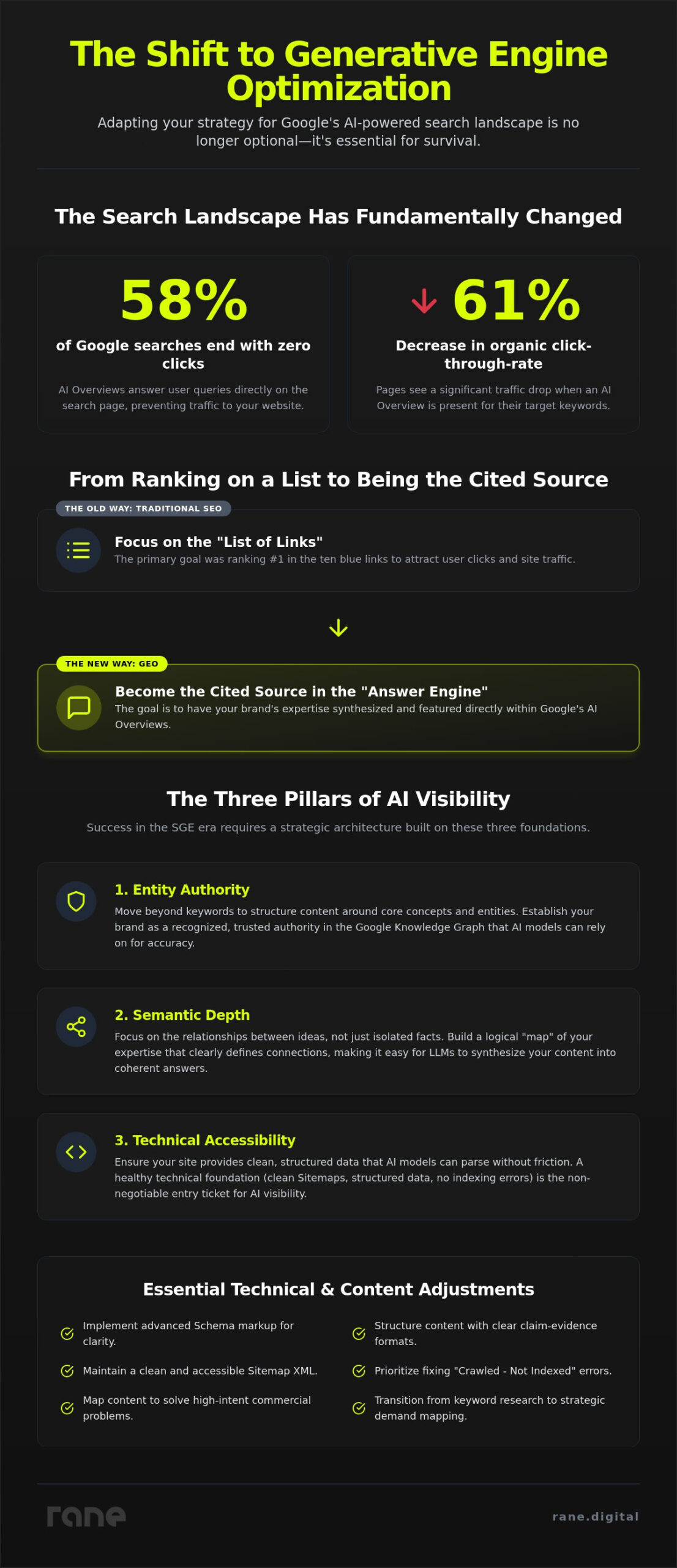
Approximately 58% of Google searches now end without a single click, a figure that’s accelerating as AI Overviews occupy the most valuable real estate on the screen. You’ve likely seen your organic traffic soften even as your keyword rankings remain stable. It’s a common frustration; traditional tactics are losing ground to a generative engine that summarizes your expertise before a user can visit your site. Learning how to adapt SEO for SGE is no longer a speculative exercise but a necessary pivot for maintaining commercial visibility.
This article provides the exact architectural framework required to move beyond the “list of links” era and secure your position as a trusted entity in the Google Knowledge Graph. You’ll discover how to optimize for the May structural updates, including the new Expert Advice blocks and inline citation requirements. We’ll move from basic keyword targeting to a sophisticated strategy of Generative Engine Optimization (GEO) that protects your search-driven revenue. By the end of this guide, you’ll have a clear plan to ensure your brand remains the primary source that Google’s AI models are forced to cite for accuracy.
Key Takeaways
- Understand the fundamental shift from a “list of links” model to a generative answer engine that prioritizes direct information synthesis.
- Learn how to adapt SEO for SGE by moving beyond keyword-centric tactics toward a framework of entity authority and semantic depth.
- Identify high-intent commercial problems through strategic demand mapping to ensure your content aligns with the specific problems AI models aim to solve.
- Implement technical optimizations, including advanced Schema markup and claim-evidence structures, to increase the probability of being cited in AI Overviews.
- Build a sustainable competitive advantage by establishing your brand as a definitive, trusted source within the Google Knowledge Graph.
How does Google Search Generative Experience (SGE) redefine search performance?
SGE transforms Google from a search engine into an answer engine using Large Language Models to synthesise web data into direct responses. This evolution replaces the legacy “Ten Blue Links” model with a Generative Overview, a shift that fundamentally alters how users interact with information. For brands, the priority is no longer just ranking at the top of a list; it’s about becoming the cited source within Google’s AI Overviews. As of May 2026, these summaries appear in roughly 25.8% of all U.S. searches, creating a new environment where AI Visibility is the primary indicator of digital performance.
The year represents a definitive tipping point for search strategy. With reports indicating that some pages experience a 61% decrease in organic click-through rates when an AI Overview is present, businesses can’t rely on traditional keyword density alone. Success now requires a transition toward becoming a verified entity that AI models trust to maintain accuracy. This shift changes the “so what” of SEO; we aren’t just chasing traffic, we’re securing a position in a synthesised narrative. Understanding how to adapt SEO for SGE is the only way to protect search-driven revenue in this automated landscape.
Understanding the Generative AI SERP Layout
The AI Overview now dominates the top of the search results page, pushing traditional organic results further down the fold. This layout introduces a conversational funnel where “Follow-up” questions allow users to refine their intent without ever leaving the Google interface. It’s a closed loop. There is now a sharp distinction between organic link-based traffic and citation-based AI traffic. While the former relies on a user clicking a blue link, the latter depends on your content being featured as a source within the AI’s response. Brand recognition is vital here, especially since the May update introduced hover previews that display site names and page titles directly within the AI block.
Why traditional SEO foundations still matter
Technical site health remains the entry ticket for LLM discovery because AI models require clean, structured data to parse information accurately. If your site has technical friction, the AI will simply bypass it for a more accessible source. A clean Sitemap XML is essential for ensuring that Google’s crawlers can find and index your most authoritative pages quickly. We often see businesses struggle with “Crawled – Currently Not Indexed” errors, which act as a direct barrier to AI visibility. If the model can’t index the page, it can’t cite the content. Traditional SEO foundations provide the structural clarity that allows generative engines to understand your commercial intent and expertise.
What are the core pillars of AI Visibility in a generative landscape?
AI Visibility relies on three fundamental pillars: Entity Authority, Semantic Depth, and Technical Accessibility. This framework represents a departure from traditional keyword-centric tactics, shifting the focus toward how generative models retrieve and synthesize information. In this environment, Google’s Knowledge Graph acts as a validation layer, cross-referencing your site’s claims against established facts and external citations to determine reliability. To succeed, businesses must adapt SEO strategies for SGE by prioritizing a “strategic partnerure” that maps commercial demand to specific, authoritative entities. This ensures your brand isn’t just a collection of keywords but a recognized authority that AI models trust to maintain accuracy.
Moving to Entity SEO ensures your content is structured around concepts rather than strings. This transition is critical because LLMs don’t just “read” text; they identify relationships between ideas. If your site structure fails to define these relationships clearly, the generative engine will struggle to cite you as a primary source. You’re effectively building a map that the AI follows to find the most relevant answers for its users. strategic partnerure is the blueprint for this map, allowing you to capture demand at the precise moment it’s generated.
How do Entity Authority and the Knowledge Graph validate your brand?
Entity Authority is established when Google recognizes your brand as a distinct entity with clearly defined attributes and a history of reliable expertise. This isn’t achieved through internal content alone. It requires a robust presence across the digital ecosystem, where Digital PR and external citations serve as the new “backlinks” for the generative era. When high-authority third-party sites reference your expertise, it signals to Google that your brand is a trustworthy component of the Knowledge Graph. Establishing this level of AI Visibility is what separates temporary traffic spikes from long-term search dominance. It’s about being the source the AI cannot afford to ignore.
How do Semantic Depth and Information Gain prevent SGE exclusion?
Semantic Depth ensures your content provides a comprehensive answer that addresses the nuances of a user’s intent, while Information Gain rewards you for providing unique data not found elsewhere. Repeating what already exists leads to SGE exclusion because the model has no incentive to cite redundant information. To combat this, you’ll need to structure content to answer the “next” logical question in a user’s journey. Using commercial search intelligence allows you to align your content with high-intent buyer journeys, providing the specific evidence and perspectives that AI models require to generate comprehensive answers. This depth makes your content indispensable to the generative process, securing your place in the AI-driven funnel.
How do you transition from keyword research to strategic demand mapping?
Strategic demand mapping replaces traditional keyword research by identifying the underlying intent and commercial problems users solve through search. While legacy tools focus on search volume for specific strings, Keyword Mapping serves as the blueprint for capturing generative search traffic by organizing content around the actual problems your audience is trying to solve. Understanding how to adapt seo for SGE requires a move toward “Intent Clusters.” These are groups of related queries that Google’s AI Overview is likely to consolidate into a single generative snapshot. By mapping these clusters, you ensure your content remains the definitive source for a broad range of conversational queries that represent real commercial demand.
This transition changes the fundamental goal of your search strategy. We aren’t just looking for high-volume terms; we’re identifying the specific friction points in a buyer’s journey. When you map demand, you’re aligning your expertise with the way Large Language Models synthesize information. This approach allows you to maintain visibility across the entire search experience, even as Google moves away from the traditional list of links toward a more integrated, answer-first interface.
The Demand Mapping Methodology
To identify high-intent traffic that traditional tools often miss, you must segment demand into informational, commercial, and transactional buckets specifically tuned for AI retrieval. This process involves analyzing the “Follow-up” questions Google suggests to uncover the deeper layers of a buyer’s journey. Using AI SEO allows you to predict emerging search patterns before they appear in standard database updates. This proactive approach is a core part of adapting SEO strategies for Google SGE, as it focuses on capturing demand at the moment of intent rather than chasing historical search volume data.
Aligning Content with the Conversational Funnel
Pages must be structured to serve as the definitive answer for specific intent clusters to win the AI Snapshot. This is where Topical Authority becomes the decisive factor; the generative engine prioritizes sources that demonstrate a comprehensive understanding of a subject. We recommend transitioning from traffic volume metrics to revenue-aligned visibility metrics. In the SGE era, a “zero-click” search that features your brand as the primary expert is often more valuable than a high-volume click that fails to convert. Success is measured by your ability to stay present throughout the user’s conversational journey, from the initial query to the final commercial resolution.
What specific technical and content adjustments optimize for AI citations?
Optimising for SGE citations requires clear claim-and-evidence structures, advanced Schema markup, and high information density. To understand how to adapt seo for SGE, you must treat your website as a structured database rather than just a collection of pages. Implementing advanced Schema markup, specifically Organization, Product, and FAQ types, provides the machine-readable layer that allows Google’s AI to categorize your expertise with precision. This technical foundation ensures that when the generative engine synthesizes an answer, it has the specific data points needed to validate your brand as a reliable source.
Beyond the code, you’ll need to adopt a ‘Claim-First’ paragraph structure. This involves stating your primary conclusion in the opening sentence, followed immediately by supporting data or expert insight. This format makes your content significantly easier for AI models to extract and summarize. Additionally, you should integrate multimedia elements with descriptive alt-text and transcripts. Google’s transition toward multimodal search means that images and video are now active participants in the generative snapshot. Finally, perform an ‘AI Citability’ audit on your key commercial pages. Every factual claim must be backed by verifiable data or documented experience to survive the accuracy filters of modern AI models.
How do you engineer content for LLM extraction?
Writing for AI requires a high signal-to-noise ratio to ensure your most valuable points aren’t buried in filler. We recommend a ‘Snippet-Ready’ format where the first sentence following every H2 directly answers the heading’s question. This is the exact text the AI is most likely to consume for its overview. Use lists and tables for comparison blocks; these structures are the preferred formats for SGE when it displays product features or service benefits. Avoid robotic transitions that dilute your message. Every word should contribute to the user’s understanding or provide a new piece of information that the model can cite.
What are the technical search foundations for the SGE era?
Technical health remains the bedrock of AI visibility because latency can cause the generative engine to skip your content in favor of a faster source. Site speed and Core Web Vitals are more critical than ever in this automated landscape. Since SGE is a mobile-heavy experience, your mobile-first indexing must be flawless to ensure content is parsed correctly. RANE fixes site structure to ensure maximum crawl efficiency, removing the friction that often prevents AI models from discovering your most valuable insights. If you’re ready to secure your position in the AI-driven landscape, you can book a strategy consultation to begin your transition.
How can businesses build a sustainable competitive advantage through AI SEO?
A sustainable advantage is built by establishing a brand as the undisputed authority in its niche through consistent, data-backed AI Visibility strategies. This approach moves beyond defensive tactics and positions your business as a primary pillar of the Knowledge Graph. By prioritizing SEO authority building, you create a long-term defense against the volatility of AI-driven traffic shifts. This ensures that as Google’s generative models evolve, your brand remains the definitive source that the engine is trained to prioritize. Understanding how to adapt seo for SGE is ultimately about building a moat around your digital reputation that competitors cannot easily replicate.
Transforming search data into Commercial Intelligence allows you to drive business decisions that extend far beyond the marketing department. You aren’t just looking at clicks; you’re analyzing how the market articulates its most pressing commercial problems. An AI SEO agency acts as a strategic partner in this process, ensuring that every content asset and technical adjustment serves a broader business objective. This alignment ensures that your search presence remains a predictable engine for revenue growth rather than a series of disconnected experiments. It’s a shift from chasing algorithms to owning the information landscape.
Building the AI Visibility Moat
Establishing a moat requires a continuous feedback loop between search performance and product development. When you identify new intent clusters through GEO, you gain a first-mover advantage that can lead to years of citation dominance. This isn’t just about visibility; it’s about PPC demand capture. By being the first entity to provide a definitive, data-backed answer to a complex query, you set the benchmark that all subsequent AI summaries must follow. This creates a compounding effect where your authority grows with every citation the engine generates, making it increasingly difficult for newer entrants to displace your position.
Next Steps for Strategic Search Dominance
The first step toward securing your position is conducting a comprehensive AI Visibility audit to identify where your current content falls short of generative requirements. This audit evaluates your current entity strength, semantic coverage, and technical accessibility to uncover specific friction points, such as missing schema or low information gain scores. This is not a one-time fix. The generative landscape is evolving rapidly, requiring continuous monitoring of how AI Overviews interpret your brand’s expertise. We invite you to book a strategy session to map your brand’s AI future and ensure you have a clear, actionable plan for search dominance. Proactive adaptation is the difference between losing traffic and owning the new search paradigm.
SGE SEO audit checklist
SGE (Search Generative Experience) was Google’s test name for what became AI Overviews, and plenty of people still search for an SGE audit. The checks are the same either way. Run them on your ten most important pages first, then work down the list.
- Is the page indexed? Inspect the URL in Google Search Console. AI Overviews pull from pages in Google’s index, so a page stuck in Crawled, currently not indexed cannot be cited.
- Is the main content in the HTML? Use View crawled page in the URL Inspection tool and check that your key text, headings and links are there without relying on scripts.
- Does each section open with a direct answer? Put a clear, quotable answer of two or three sentences straight under each heading, then add the detail.
- Do your headings match how people ask? Phrase H2s and H3s as the real questions your buyers type or speak.
- Is your structured data valid? Run the page through the Rich Results Test and fix errors in your Article, Organization and Service schema.
- Is it clear who wrote it and who you are? Show a named author or team, link to your about and contact pages, and keep your business name, address and phone number the same everywhere.
- Does the page add something new? Original numbers, examples, screenshots or client results give AI answers a reason to cite you instead of the ten pages that say the same thing.
- Are there duplicate versions? Check canonicals so Google picks the URL you want. Our guide to duplicate without user-selected canonical covers the fix.
- Is it fast and stable on mobile? Check the Core Web Vitals report in Search Console and fix pages marked poor.
- Are you cited today? Search your top questions, note whether an AI Overview appears and which sources it cites, and log the result every month so you can see movement.
Want this run across your whole site? Our AI visibility service checks what Google AI Overviews, ChatGPT and Perplexity say about you, fixes what is wrong and tracks it every month. Agencies can offer the same audit to their clients through our white label service.
Securing Your Brand’s Future in the Generative Era
The transition to AI-led answers is a permanent structural shift that requires moving beyond the traditional list of links. It’s no longer enough to rank. Your brand must be recognized as a definitive entity within the Knowledge Graph. By prioritizing entity authority and technical precision, you ensure your expertise remains the primary source that Google’s generative models are trained to prioritize. This shift replaces the uncertainty of traffic volatility with the stability of established authority.
Mastering how to adapt seo for SGE is ultimately a matter of strategic partnerure. It involves replacing high-volume keyword chasing with revenue-aligned demand mapping and information-dense content that LLMs can easily cite. This approach transforms search from a simple traffic source into a predictable engine for long-term commercial growth. When your content is engineered for extraction, your brand becomes an indispensable part of the user’s conversational journey.
As AI-focused search and performance specialists, RANE applies a proven ‘strategic partner’ methodology to help you navigate this transition with total control. We focus on securing visibility that translates directly into business intelligence and sustainable revenue. Ready to dominate the new search landscape? Book a strategy session with RANE to secure your AI Visibility and lead your niche into the generative future.
Frequently Asked Questions
What is the difference between traditional SEO and SGE optimization?
Traditional SEO focuses on ranking in a static list of links, while SGE optimization prioritizes becoming a cited entity within a generative answer. The shift requires moving from keyword frequency to semantic depth and technical clarity. Learning how to adapt seo for SGE means you’re no longer just optimizing for a search engine; you’re optimizing for an answer engine that synthesizes data into direct responses.
Will SGE kill organic search traffic for my business?
SGE won’t eliminate search traffic, but it will fundamentally redistribute it toward authoritative sources cited in AI Overviews. While some informational queries may see a drop in click-through rates, high-intent commercial queries offer new opportunities for brands that establish themselves as trusted experts. Success depends on your ability to capture demand within the generative snapshot rather than relying on legacy blue links.
How do I get my website featured in Google’s AI Overview?
You get featured by providing clear, authoritative answers supported by advanced Schema markup and unique information gain. Google’s models prioritize content that is easily extractable, highly relevant to user intent, and validated by external citations in the Knowledge Graph. Structuring your content with a claim-first approach and using lists or tables for data comparison increases the probability of being selected as a primary source.
Does keyword density still matter for SGE?
Keyword density is largely irrelevant in an environment where models prioritize topical authority and semantic relationships over word frequency. You should focus on answering the user’s commercial problems comprehensively rather than hitting specific percentage thresholds for a single string. The generative engine looks for the “so what” of your content, rewarding depth and clarity over repetitive keyword placement.
Can AI-generated content rank well in SGE?
AI-generated content can rank if it provides high information gain and meets Google’s E-E-A-T standards, but generic outputs are often excluded. The engine seeks unique perspectives and data-backed insights that a model cannot simply scrape from common sources. To maintain visibility, you must infuse AI-assisted content with proprietary data, expert experience, and a distinct brand voice that adds genuine value to the search ecosystem.
How do I measure success in an AI-driven search environment?
Success is measured through brand mentions, citation frequency, and impressions within AI Overviews rather than traditional click-through rates alone. You must align your KPIs with revenue-driven visibility and your brand’s presence in the conversational funnel. New reports in Search Console now provide data on impressions within AI Mode, allowing you to track how often your brand serves as a definitive source for generative answers.
What is Generative Engine Optimization (GEO) and do I need it?
GEO is the specialized practice of optimizing content to be consumed and cited by generative models like AI Overviews. Every business that relies on search-driven revenue needs a GEO strategy to maintain commercial visibility as Google moves away from the legacy search model. It involves a systematic approach to building entity authority and ensuring your technical foundation is accessible to Large Language Models.
Disclaimer
The information provided on this blog is for general informational and educational purposes only. While we strive to provide accurate and up-to-date content, the opinions and insights expressed here represent our best marketing judgments and should not be taken as professional, legal, or financial advice. Any reference to third-party websites or external links is provided for convenience and does not imply endorsement; we are not responsible for their content or accuracy. Digital marketing results vary based on individual effort, budget, and market conditions; we make no guarantees or warranties regarding specific outcomes or performance metrics resulting from the use of this information.
Want help with this? See our AI visibility services or book a discovery call.